 📸 Photo
Photo: http://opencage · CC BY-SA 3.0 · Wikimedia Commons Source
Freshwater minnow
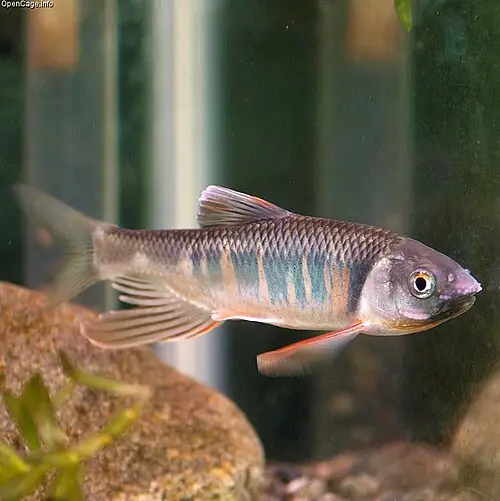
Zacco platypus (Freshwater minnow · オイカワ)
💡 Everyday Comparisons for Size, Mass & Speed
- 💡 Its maximum total length of 22.5 cm is three-quarters the length of a 30 cm ruler (Comparison).
- 💡 It is easily seen in riffles of clear middle river reaches and is distributed in rivers nationwide (National List of Species of Korea).
- 💡 FishBase classifies it as a minor commercial fish species.
Reference standards: coach bus ~12 m, mid-size car ~4.9 m, compact car ~1 t, basketball hoop 3.05 m, credit card 8.56 cm.
Site-computed relative index from recorded values; not a formal scientific metric.
📖 1. Overview
The freshwater minnow is a common freshwater fish in riffles of clear middle river reaches and also lives in China, Japan, and Taiwan. Its body is an elongated, flattened spindle shape with a bluish sheen.
🦴 2. Anatomy & Morphology
Its body is long and flattened, and the upper jaw is longer than the lower jaw. During the spawning season, the underside of the male's head turns dark red, red bands appear on the fins, and the caudal peduncle takes on a yellow tint.
🔍 3. Ecology & Behavior
It feeds on aquatic insect larvae and attached algae on gravel and sand, and FishBase notes that it also eats zooplankton, small crustaceans, algae, small fish, and detritus. From May to July, males prepare spawning beds on sandy bottoms and attract females to lay eggs.
🇰🇷 4. Connection to Korea
It is listed on the National List of Species of Korea and inhabits all of Korea except northern rivers flowing into the East Sea.
📚 Sources & References
- • IUCN Red List LC (2023) — https://www.iucnredlist.org/species/166949/1155994
- • IUCN Red List category LC — latest assessment at iucnredlist.org
- • catalogueoflife.org — 7GCFK
- • iucnredlist.org — 1155994
- • 국가생물종목록(국립생물자원관) ktsn 120000057645 — https://species.nibr.go.kr/home/mainHome.do?cont_link=009&subMenu=009002&contCd=009002&ktsn=120000057645
- • wikidata.org — Q1074240
- • commons.wikimedia.org — File:Zacco platypus.jpg
- • fishbase.se — Zacco-platypus.html
- • species.nibr.go.kr — mainHome.do
- • Silhouette: PhyloPic — Carlos Cano-Barbacil · CC0 1.0 (Related taxon silhouette — Luciobarbus graellsii)
Recorded dimensions are widely cited representative estimates from public literature and may vary by study or specimen.