 🎨 Restoration
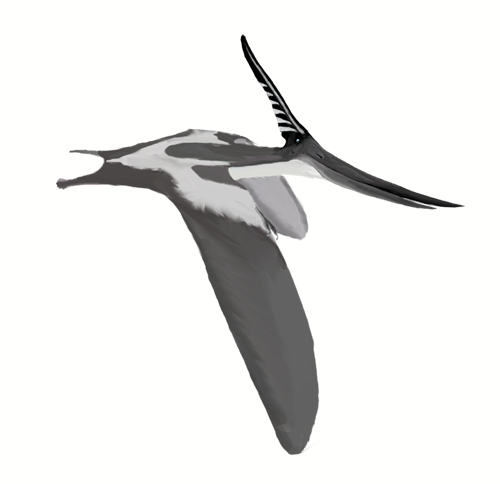
Life restoration of an adult male P. longiceps in flight
Restoration: Matt Martyniuk · CC BY 3.0 · Wikimedia Commons Source
Life restorations are artistic reconstructions based on fossil evidence; true coloration and soft-tissue details remain uncertain.
Pteranodon
Pteranodon longiceps (Pteranodon · プテラノドン)
Known only from fossils. The IUCN Red List assesses only species extant since 1500 CE, so fossil taxa are not assigned a category.
💡 Everyday Comparisons for Size, Mass & Speed
- 🪽 Wingspan 6.5m — Wingspan is ~3.7× the height of a 1.75 m human
- 🏢 Height 1.8m — ~1× the height of a 1.75 m human
- ⚖️ Mass 35kg — Equivalent to ~17.5 two-liter water bottles (2 kg each)
- ⚡ Speed 80km/h — ~2.1× Usain Bolt's 100 m world-record average speed (37.6 km/h)
Reference standards: coach bus ~12 m, mid-size car ~4.9 m, compact car ~1 t, basketball hoop 3.05 m, credit card 8.56 cm.
Site-computed relative index from recorded values; not a formal scientific metric.
📖 1. Overview
A representative pterosaur of Late Cretaceous North America—with large males reaching wingspans over 6 m—it caught fish using its long, toothless beak.
🌐 Wikipedia Summary ExtractPteranodon is a genus of pterosaur that included some of the largest known flying reptiles, with P. longiceps having a wingspan of over 6 m (20 ft). They lived during the late Cretaceous geological period of North America in present-day Kansas, Nebraska, Wyoming, South Dakota and Alabama. More fossil specimens of Pteranodon have been found than any other pterosaur, with about 1,200 specimens known to science, many of them well preserved with nearly complete skulls and articulated skeletons. It was an important part of the animal community in the Western Interior Seaway.
🦴 2. Anatomy & Morphology
Its elongated fourth finger supported the wing membrane, and thanks to its thin, hollow bones, it weighed only 35 kg.
🔍 3. Fossil Record & Paleoecology
More than 1,200 fossils have been excavated, revealing even its sexual dimorphism (the large head crest in males).
🇰🇷 4. Connection to Korea
Together with the pterosaur footprint fossils of Uhang-ri, Haenam, it is a benchmark species for understanding Cretaceous sky ecosystems.
📚 Sources & References
- • Wikipedia “Pteranodon”
- • Wikidata Q41219249
- • Fossil taxon — the IUCN Red List assesses only species living or extinct since 1500
- • pmc.ncbi.nlm.nih.gov — PMC6296329
- • Silhouette: PhyloPic — Matt Dempsey · CC BY 4.0
Recorded dimensions are widely cited representative estimates from public literature and may vary by study or specimen.