 📸 Photo
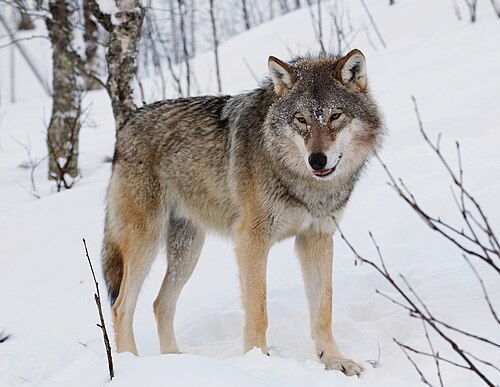
Eurasian wolf at Polar Zoo in Bardu, Norway
Photo: User:Mas3cf · CC BY-SA 4.0 · Wikimedia Commons Source
Gray Wolf
Canis lupus (Gray Wolf · ハイイロオオカミ)
💡 Everyday Comparisons for Size, Mass & Speed
- 📏 Length 1m — ~3.4× the long side of an A4 sheet (29.7 cm)
- ⚖️ Mass 30kg — Equivalent to ~15 two-liter water bottles (2 kg each)
- ⚡ Speed 60km/h — ~1.6× Usain Bolt's 100 m world-record average speed (37.6 km/h)
Reference standards: coach bus ~12 m, mid-size car ~4.9 m, compact car ~1 t, basketball hoop 3.05 m, credit card 8.56 cm.
Site-computed relative index from recorded values; not a formal scientific metric.
📖 1. Overview
The largest member of the dog family and the wild ancestor of all domestic dogs, boasting tight-knit family-centered pack societies and long-distance pursuit endurance.
🌐 Wikipedia Summary ExtractThe wolf, also known as the grey wolf or gray wolf, is a canine native to Eurasia and North America. More than thirty subspecies of Canis lupus have been recognized, including the dog and dingo, though grey wolves, as popularly understood, include only naturally occurring wild subspecies. The wolf is the largest wild extant member of the family Canidae, and is further distinguished from other Canis species by its less pointed ears and muzzle, as well as a shorter torso and a longer tail. The wolf is nonetheless related closely enough to smaller Canis species, such as the coyote and the golden jackal, to produce fertile hybrids with them. The wolf's fur is usually mottled white, brown, grey, and black, although subspecies in the arctic region may be nearly all white.
🦴 2. Anatomy & Morphology
It is equipped with cardiorespiratory endurance to run over 60 km a day and carnassial teeth (molars) that crush bones to extract marrow.
🔍 3. Ecology & Behavior
It is the flagship keystone species of the 'trophic cascade' that restored the Yellowstone National Park ecosystem.
🇰🇷 4. Connection to Korea
Listed as Class I endangered wildlife (Korea) by the Ministry of Environment, genetic conservation and restoration research on the Korean wolf is underway.
📚 Sources & References
- • Wikipedia “Wolf”
- • Wikidata Q18498
- • IUCN Red List category LC — latest assessment at iucnredlist.org
- • animaldiversity.org — Canis lupus
- • Silhouette: PhyloPic — Steven Traver · CC0 1.0
Recorded dimensions are widely cited representative estimates from public literature and may vary by study or specimen.