 🎨 Restoration
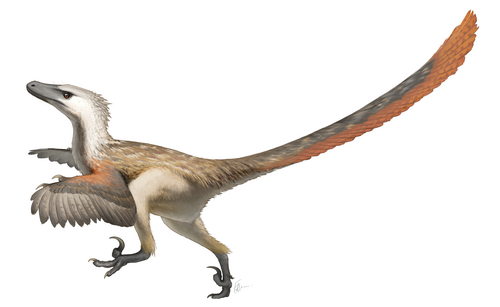
Life restoration
Restoration: Fred Wierum · CC BY-SA 4.0 · Wikimedia Commons Source
Life restorations are artistic reconstructions based on fossil evidence; true coloration and soft-tissue details remain uncertain.
Velociraptor
Velociraptor mongoliensis (Velociraptor · ヴェロキラプトル)
Known only from fossils. The IUCN Red List assesses only species extant since 1500 CE, so fossil taxa are not assigned a category.
💡 Everyday Comparisons for Size, Mass & Speed
- 📏 Length 1.8m — ~1× the height of a 1.75 m adult human
- ⚖️ Mass 7kg — Equivalent to ~3.5 two-liter water bottles (2 kg each)
- ⚡ Speed 40km/h — ~1.1× Usain Bolt's 100 m world-record average speed (37.6 km/h)
Reference standards: coach bus ~12 m, mid-size car ~4.9 m, compact car ~1 t, basketball hoop 3.05 m, credit card 8.56 cm.
Site-computed relative index from recorded values; not a formal scientific metric.
📖 1. Overview
It is a small feathered theropod bearing a sharp, sickle-shaped claw on the second toe of each hind foot.
🌐 Wikipedia Summary ExtractVelociraptor is a genus of small dromaeosaurid dinosaurs that lived in Asia during the Late Cretaceous epoch, about 75 million to 71 million years ago (Mya). Two species are currently recognized, although others have been assigned in the past. The type species is V. mongoliensis, named and described in 1924. Fossils of this species have been discovered in the Djadochta Formation, Mongolia. A second species, V. osmolskae, was named in 2008 for skull material from the Bayan Mandahu Formation, China. A possible record is known from the Nemegt Formation.
🦴 2. Anatomy & Morphology
The discovery of quill knobs on the ulna of its forelimb confirmed that its body and forelimbs were covered with well-developed feathers.
🔍 3. Fossil Record & Paleoecology
It is famous for the 'Fighting Dinosaurs' specimen, fossilized locked in combat with a Protoceratops.
🇰🇷 4. Connection to Korea
Dromaeosaurid footprint fossils preserved at a world-class level have been found in the Cretaceous strata of Jinju and Haenam.
📚 Sources & References
- • Wikipedia “Velociraptor”
- • Wikidata Q1420827
- • Fossil taxon — the IUCN Red List assesses only species living or extinct since 1500
- • nhm.ac.uk — velociraptor.html
- • Silhouette: PhyloPic — author not recorded · CC0 1.0
Recorded dimensions are widely cited representative estimates from public literature and may vary by study or specimen.