 📸 Photo
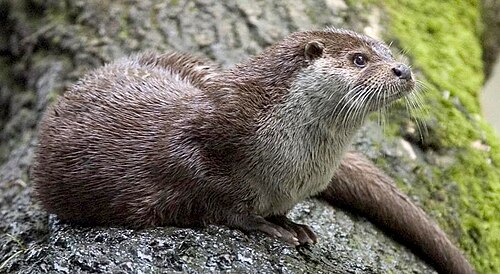
European Otter ( Lutra lutra ).
Photo: Bernard Landgraf · CC BY-SA 3.0 · Wikimedia Commons Source
Eurasian Otter
Lutra lutra (Eurasian Otter · ユーラシアカワウソ)
💡 Everyday Comparisons for Size, Mass & Speed
- 📏 Length 64cm — ~2.2× the long side of an A4 sheet (29.7 cm)
- ⚖️ Mass 5kg — Equivalent to ~2.5 two-liter water bottles (2 kg each)
- ⚡ Speed 28km/h — ~0.7× Usain Bolt's 100 m world-record average speed (37.6 km/h)
Reference standards: coach bus ~12 m, mid-size car ~4.9 m, compact car ~1 t, basketball hoop 3.05 m, credit card 8.56 cm.
Site-computed relative index from recorded values; not a formal scientific metric.
📖 1. Overview
An apex predator of Korea's freshwater stream ecosystems and a keystone species representing water quality health, designated as Natural Monument (Korea) No. 330.
🌐 Wikipedia Summary ExtractThe Eurasian otter, also known as the European otter, Eurasian river otter, European river otter, common otter, and Old World otter, is a semiaquatic mammal native to Eurasia and the Maghreb. It is the most widely distributed member of the otter subfamily (Lutrinae) of the weasel family (Mustelidae) and is found in the waterways and on the coasts of Europe, much of Asia, and parts of North Africa. The Eurasian otter eats mainly fish, and is strongly territorial. It is endangered in some parts of its range, but is recovering in others.
🦴 2. Anatomy & Morphology
It has ultra-dense waterproof underfur of 50,000 hairs per cm², webbed toes, and stiff whiskers that detect fish movements underwater.
🔍 3. Ecology & Behavior
It protects river biodiversity by controlling invasive fish species such as bluegill and bass.
🇰🇷 4. Connection to Korea
From the Hangang River and Yeouido Saetgang in Seoul to Jinyangho Lake in Jinju, it is a nationwide symbol of river ecological restoration.
📚 Sources & References
- • Wikipedia “Eurasian otter”
- • Wikidata Q29995
- • IUCN Red List category NT — latest assessment at iucnredlist.org
- • species.nibr.go.kr — mainHome.do
- • Silhouette: PhyloPic — Margot Michaud · CC0 1.0 (Related taxon silhouette — Lontra felina)
Recorded dimensions are widely cited representative estimates from public literature and may vary by study or specimen.