 📸 Photo
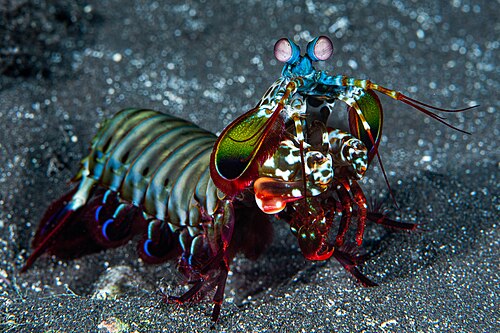
Odontodactylus scyllarus observed at la Réunion (western Indian ocean).
Photo: Cédric Péneau · CC BY-SA 4.0 · Wikimedia Commons Source
Peacock Mantis Shrimp
Odontodactylus scyllarus (Peacock Mantis Shrimp · モンハナシャコ)
Not Evaluated (NE) on the IUCN Red List yet.
💡 Everyday Comparisons for Size, Mass & Speed
- 📏 Length 3cm — ~0.4× the width of a credit card (8.56 cm)
- ⚖️ Mass 100g — Equivalent to ~1.7 chicken eggs (~60 g each)
- ⚡ Speed 72km/h — ~1.9× Usain Bolt's 100 m world-record average speed (37.6 km/h)
Reference standards: coach bus ~12 m, mid-size car ~4.9 m, compact car ~1 t, basketball hoop 3.05 m, credit card 8.56 cm.
Site-computed relative index from recorded values; not a formal scientific metric.
📖 1. Overview
Though only 18 cm long, this marine fighter shatters crabs, clam shells, and even tempered aquarium glass with 'nuclear punch' raptorial appendages that accelerate like a .22-caliber bullet (83 km/h, 1,500 N).
🌐 Wikipedia Summary ExtractOdontodactylus scyllarus, commonly known as the peacock mantis shrimp, harlequin mantis shrimp, painted mantis shrimp, clown mantis shrimp, rainbow mantis shrimp, peacock odontodactyl, thumb splitter, or simply mantis shrimp, is a large odontodactylid stomatopod native to the epipelagic seabed across the Indo-Pacific, ranging from the Marianas to East Africa, and as far South as Northern KwaZulu Natal in South Africa. It is one of roughly 480 species of mantis shrimp, which are well known for their raptorial claws, exceptional vision, and their unique way of interacting with other marine species.
🦴 2. Anatomy & Morphology
Its strike is so fast that the surrounding seawater vaporizes instantaneously, collapsing cavitation bubbles that produce a secondary shockwave and momentary heat of thousands of degrees to stun prey. It also possesses 12–16 types of photoreceptors—far beyond humans' 3 types—allowing it to see ultraviolet and circularly polarized light.
🔍 3. Ecology & Behavior
The helicoidal apatite crystal structure forming the surface of its clubs is directly mimicked in the design of next-generation body armor and aircraft composite materials.
🇰🇷 4. Connection to Korea
It is a tropical relative belonging to the same order Stomatopoda (mantis shrimps) as Oratosquilla oratoria caught in Korea's West and South Seas.
📚 Sources & References
- • Wikipedia “Odontodactylus scyllarus”
- • Wikidata Q43735
- • IUCN Red List: not evaluated (NE) — cross-checked with the Wikidata conservation-status entry
- • animaldiversity.org — Odontodactylus scyllarus
- • Silhouette: PhyloPic — T. Michael Keesey (after Mivart) · CC0 1.0 (Related taxon silhouette — Squilla mantis)
Recorded dimensions are widely cited representative estimates from public literature and may vary by study or specimen.