 📸 Photo
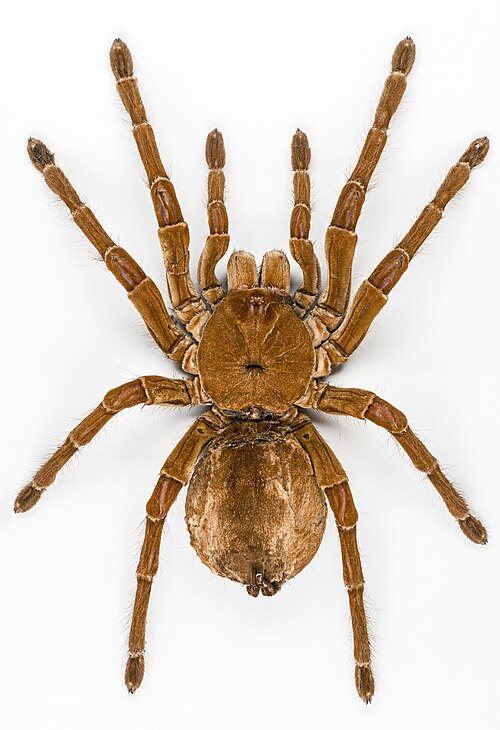
Goliath birdeater female - Dorsal side - 23,5 cm (the largest known specimen is 28 cm)— - Mounted specimen by Philippe Annoyer Locality: French Guiana , France
Photo: Didier Descouens · CC BY-SA 4.0 · Wikimedia Commons Source
Goliath Birdeater
Theraphosa blondi (Goliath Birdeater · ゴリアテバードイーター)
Not Evaluated (NE) on the IUCN Red List yet.
💡 Everyday Comparisons for Size, Mass & Speed
- 📏 Length 12cm — ~1.4× the width of a credit card (8.56 cm)
- ⚖️ Mass 100g — Equivalent to ~1.7 chicken eggs (~60 g each)
Reference standards: coach bus ~12 m, mid-size car ~4.9 m, compact car ~1 t, basketball hoop 3.05 m, credit card 8.56 cm.
Site-computed relative index from recorded values; not a formal scientific metric.
📖 1. Overview
With a leg span of 30 cm (the size of a dinner plate) and a weight of up to 175 g, it is listed in the Guinness World Records as the world's heaviest and largest spider.
🌐 Wikipedia Summary ExtractThe Goliath birdeater is a large spider that belongs to the tarantula family Theraphosidae. Found in northern South America, it is the largest spider in the world by mass and body length, and second to the giant huntsman spider by leg span. It is also considerably longer than the largest known prehistoric spider, Mongolarachne, that had a body length of 2.46 centimeters (0.97 in). It is also called the Goliath tarantula or Goliath bird-eating spider; the practice of calling theraphosids "bird-eating" derives from an early 18th-century copper engraving by Maria Sibylla Merian that shows one eating a hummingbird. Despite the spider's name, it rarely preys on birds.
🦴 2. Anatomy & Morphology
Along with massive fangs (chelicerae) reaching 2–3 cm in length, when threatened it rubs its hind legs against its abdomen to flick microscopic harpoon-shaped urticating hairs that attack a predator's eyes and respiratory tract.
🔍 3. Ecology & Behavior
Although its name is 'birdeater,' its staple diet in the wild actually consists of large earthworms, frogs, lizards, and rodents.
🇰🇷 4. Connection to Korea
It is a representative species illustrating the structural size limits of Arachnida and the principle of hydraulic leg locomotion.
📚 Sources & References
- • Wikipedia “Goliath birdeater”
- • Wikidata Q617000
- • IUCN Red List: not evaluated (NE) — cross-checked with the Wikidata conservation-status entry
- • nationalzoo.si.edu — goliath-bird-eating-tarantula
- • nhm.ac.uk — the-worlds-most-extreme-spiders.html
- • Silhouette: PhyloPic — author not recorded · CC0 1.0
Recorded dimensions are widely cited representative estimates from public literature and may vary by study or specimen.