 📸 Photo
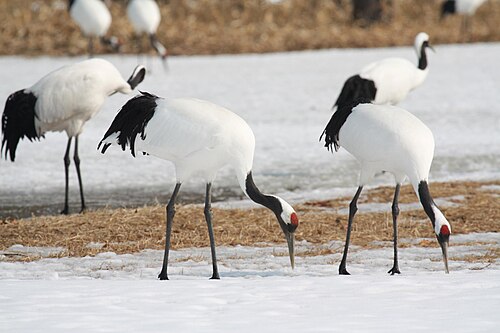
Several Red-crowned Cranes (also called the Japanese Crane or Manchurian Crane) in Hokkaido, Japan.
Photo: Alastair Rae from London, United Kingdom · CC BY-SA 2.0 · Wikimedia Commons Source
Red-crowned Crane
Grus japonensis (Red-crowned Crane · タンチョウ (丹頂鶴))
💡 Everyday Comparisons for Size, Mass & Speed
- 📏 Length 1.36m — ~0.8× the height of a 1.75 m adult human
- 🪽 Wingspan 2.2m — Wingspan is ~1.3× the height of a 1.75 m human
- 🏢 Height 1.5m — ~0.9× the height of a 1.75 m human
- ⚖️ Mass 7kg — Equivalent to ~3.5 two-liter water bottles (2 kg each)
- ⚡ Speed 65km/h — ~1.7× Usain Bolt's 100 m world-record average speed (37.6 km/h)
Reference standards: coach bus ~12 m, mid-size car ~4.9 m, compact car ~1 t, basketball hoop 3.05 m, credit card 8.56 cm.
Site-computed relative index from recorded values; not a formal scientific metric.
📖 1. Overview
Harmonizing pure white plumage, a black neck, and a red crown, it is the 'crane' (Hak) symbolizing longevity and nobility in East Asia (Natural Monument (Korea) No. 202).
🌐 Wikipedia Summary ExtractThe red-crowned crane, also called the Japanese crane and the Manchurian crane, is a large Northeast Asian crane among the rarest cranes in the world. In some parts of its range, it is known as a symbol of luck, longevity, and fidelity.
🦴 2. Anatomy & Morphology
A large bird standing 1.55 m tall with a 2.4 m wingspan, it produces clear, resonant calls thanks to a long trachea coiled inside its sternum.
🔍 3. Ecology & Behavior
Once paired, mates stay together for a long time and are famous for their courtship dance in which the male and female face each other and leap into the air.
🇰🇷 4. Connection to Korea
Every winter it visits central Korea, including the Cheorwon Plains, to overwinter, and is the bird depicted on the reverse of the South Korean 500-won coin.
📚 Sources & References
- • Wikipedia “Red-crowned crane”
- • Wikidata Q232906
- • IUCN Red List category VU — latest assessment at iucnredlist.org
- • species.nibr.go.kr — mainHome.do
- • animaldiversity.org — Grus japonensis
- • nie.re.kr — view.do
- • Silhouette: PhyloPic — Kai Caspar · CC0 1.0
Recorded dimensions are widely cited representative estimates from public literature and may vary by study or specimen.