 📸 Photo
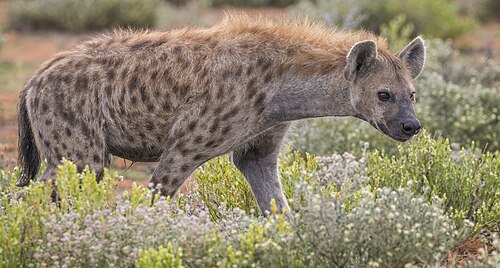
Spotted hyena ( Crocuta crocuta ), Etosha National Park, Namibia
Photo: Charles J. Sharp · CC BY-SA 4.0 · Wikimedia Commons Source
Spotted Hyena
Crocuta crocuta (Spotted Hyena · ブチハイエナ)
💡 Everyday Comparisons for Size, Mass & Speed
- 📏 Length 95cm — ~3.2× the long side of an A4 sheet (29.7 cm)
- ⚖️ Mass 45kg — Equivalent to ~22.5 two-liter water bottles (2 kg each)
- ⚡ Speed 60km/h — ~1.6× Usain Bolt's 100 m world-record average speed (37.6 km/h)
Reference standards: coach bus ~12 m, mid-size car ~4.9 m, compact car ~1 t, basketball hoop 3.05 m, credit card 8.56 cm.
Site-computed relative index from recorded values; not a formal scientific metric.
📖 1. Overview
Contrary to the stereotype of being mere scavengers, they are skilled predators that directly hunt 70–90% of their food and form complex matriarchal clan societies.
🌐 Wikipedia Summary ExtractThe spotted hyena, also known as the laughing hyena, is a hyena species, currently classed as the sole extant member of the genus Crocuta, native to sub-Saharan Africa. It is listed as being of least concern by the IUCN due to its widespread range and large numbers estimated between 27,000 and 47,000 individuals. The species is, however, experiencing declines outside of protected areas due to habitat loss and poaching. Populations of Crocuta, usually considered a subspecies of Crocuta crocuta, known as cave hyenas, roamed across Eurasia for at least one million years until the end of the Late Pleistocene. The spotted hyena is the largest extant member of the Hyaenidae, and is further physically distinguished from other species by its vaguely bear-like build, rounded ears, less prominent mane, spotted pelt, more dual-purposed dentition, fewer nipples, and pseudo-penis. It is the only placental mammalian species where females have a pseudo-penis and lack an external vaginal opening.
🦴 2. Anatomy & Morphology
With a bite force of about 4,500 N and strong stomach acid, it chews up and digests even the thick bones and hooves of giraffes and elephants without leaving a trace.
🔍 3. Ecology & Behavior
Although dog-like in appearance, phylogenetically it is closer to Feliformia (civets, mongooses, and cats) than to Canidae.
🇰🇷 4. Connection to Korea
It is a key species illustrating the role of natural sanitizers that prevent the spread of disease in savanna ecosystems.
📚 Sources & References
- • Wikipedia “Spotted hyena”
- • Wikidata Q178089
- • IUCN Red List category LC — latest assessment at iucnredlist.org
- • animaldiversity.org — Crocuta crocuta
- • Silhouette: PhyloPic — Margot Michaud · CC0 1.0
Recorded dimensions are widely cited representative estimates from public literature and may vary by study or specimen.