 📸 Photo
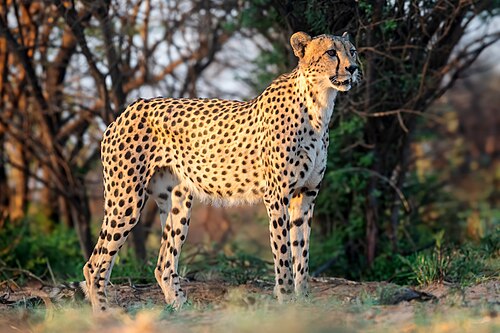
Cheetah at Working with Wildlife, South Africa
Photo: AfricanConservation · CC BY-SA 4.0 · Wikimedia Commons Source
Cheetah
Acinonyx jubatus (Cheetah · チーター)
💡 Everyday Comparisons for Size, Mass & Speed
- 📏 Length 1.12m — ~3.8× the long side of an A4 sheet (29.7 cm)
- ⚖️ Mass 21kg — Equivalent to ~10.5 two-liter water bottles (2 kg each)
- ⚡ Speed 112km/h — ~1.1× highway speed limit (100 km/h)
Reference standards: coach bus ~12 m, mid-size car ~4.9 m, compact car ~1 t, basketball hoop 3.05 m, credit card 8.56 cm.
Site-computed relative index from recorded values; not a formal scientific metric.
📖 1. Overview
The fastest land animal on Earth, accelerating from a standstill to 100 km/h in 3 seconds and sprinting at a top speed of 112 km/h.
🌐 Wikipedia Summary ExtractThe cheetah is a species of large feline and the only living member of the genus Acinonyx. The cheetah is a pursuit predator and the fastest land animal, capable of running at 93–104 km/h (58–65 mph); it has evolved for speed, having powerful hindlimb muscles and a long lumbar spine. The cheetah has a tawny to creamy white or pale buff fur that is marked with evenly spaced, solid black spots. The head is small and rounded, with a short snout and black tear-like facial streaks. It has a height of 67–94 cm (2.20–3.08 ft) at the shoulder, and the head-and-body length is between 1.1 and 1.5 m. Adults weigh between 21 and 65 kg.
🦴 2. Anatomy & Morphology
It has a spine that bends like a spring, semi-retractable claws that act as cleats, and a long tail that functions as a rudder.
🔍 3. Ecology & Behavior
Because a single sprint generates immense body heat, if it fails to catch a gazelle within 20–30 seconds, it stops the chase to catch its breath.
🇰🇷 4. Connection to Korea
It serves as a prime biomimetic engineering model for high-speed quadruped robots at institutions such as KAIST.
📚 Sources & References
- • Wikipedia “Cheetah”
- • Wikidata Q23907
- • IUCN Red List category VU — latest assessment at iucnredlist.org
- • animaldiversity.org — Acinonyx jubatus
- • nationalzoo.si.edu — cheetah
- • Silhouette: PhyloPic — nicubunu · CC0 1.0
Recorded dimensions are widely cited representative estimates from public literature and may vary by study or specimen.