 📸 Photo
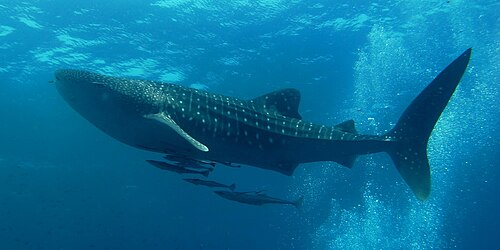
Whale shark at the Andaman sea
Photo: Abe Khao Lak · CC BY-SA 4.0 · Wikimedia Commons Source
Whale Shark
Rhincodon typus (Whale Shark · ジンベエザメ)
💡 Everyday Comparisons for Size, Mass & Speed
- 📏 Length 14m — ~1.2× the length of a 12 m coach bus
- 🏢 Height 2.5m — ~1.4× the height of a 1.75 m human
- ⚖️ Mass 19t — Equivalent to ~19 compact cars (~1 t each)
- ⚡ Speed 12km/h — ~3× human walking speed (~4 km/h)
Reference standards: coach bus ~12 m, mid-size car ~4.9 m, compact car ~1 t, basketball hoop 3.05 m, credit card 8.56 cm.
Site-computed relative index from recorded values; not a formal scientific metric.
📖 1. Overview
Reaching 12–18 m in length and 20 tonnes in weight, it is a gentle filter-feeding shark and the largest of all living fish.
🌐 Wikipedia Summary ExtractThe whale shark is a slow-moving, filter-feeding carpet shark and the largest known extant fish species. An individual with a length of 18.8 m (61.7 ft) has been considered the largest reliably recorded. The whale shark holds many records for size in the animal kingdom, most notably being by far the largest living non-cetacean animal. It is the only living species of the genus Rhincodon and the only extant member of the family Rhincodontidae, which belongs to the subclass Elasmobranchii in the class Chondrichthyes. Before 1984, it was classified as Rhiniodon into Rhinodontidae. An extinct species, Rhincodon ferriolensis, was described in Europe, in the Late Burdigalian stage.
🦴 2. Anatomy & Morphology
The pattern of white spots and stripes on its back is unique to each individual like a human fingerprint, and with its 1.5 m-wide mouth it filters 6,000 liters of seawater per hour to feed on plankton.
🔍 3. Ecology & Behavior
Even the surface of its eyeballs is covered with tiny tooth-like scales (dermal denticles) to protect the eyes from external impact.
🇰🇷 4. Connection to Korea
It is a protected marine species observed during summer along the coast of Jeju Island and in the South Sea.
📚 Sources & References
- • Wikipedia “Whale shark”
- • Wikidata Q80378
- • IUCN Red List category EN — latest assessment at iucnredlist.org
- • fishbase.se — Rhincodon-typus.html
- • Silhouette: PhyloPic — Christoph Schomburg · CC0 1.0
Recorded dimensions are widely cited representative estimates from public literature and may vary by study or specimen.