 📸 Photo
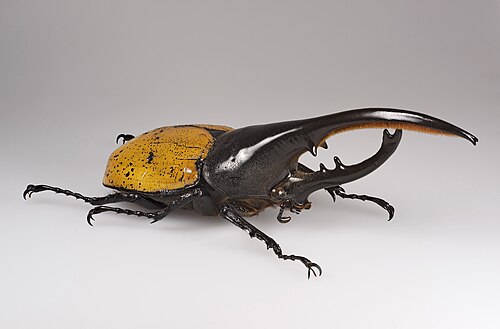
Hercules beetle ♂ - 15.5 cm Locality: Iquitos , Loreto, Northern Peru
Photo: Didier Descouens · CC BY-SA 4.0 · Wikimedia Commons Source
Hercules Beetle
Dynastes hercules (Hercules Beetle · ヘラクレスオオカブト)
Not Evaluated (NE) on the IUCN Red List yet.
💡 Everyday Comparisons for Size, Mass & Speed
- 📏 Length 4.4cm — ~0.5× the width of a credit card (8.56 cm)
- ⚖️ Mass 11.5g — Equivalent to ~0.2 chicken eggs (~60 g each)
- ⚡ Speed 16km/h — ~4× human walking speed (~4 km/h)
Reference standards: coach bus ~12 m, mid-size car ~4.9 m, compact car ~1 t, basketball hoop 3.05 m, credit card 8.56 cm.
Site-computed relative index from recorded values; not a formal scientific metric.
📖 1. Overview
Reaching up to 18 cm in length including its thoracic horn, it is the world's longest and strongest rhinoceros beetle, named after the Greek mythological hero Heracles.
🌐 Wikipedia Summary ExtractThe Hercules beetle is a species of rhinoceros beetle native to the tropical forests of southern Mexico, Central America, South America, and the Lesser Antilles. It is the longest extant species of beetle in the world, and is also one of the largest flying insects in the world.
🦴 2. Anatomy & Morphology
Anti-slip golden fine hairs grow along the underside of its long thoracic horn, which interlocks like pincers with its head horn to lift rival males and hurl them off trees.
🔍 3. Ecology & Behavior
The 3D nanoporous chitin structure of its elytra (forewings) acts as a natural hygrometer, appearing golden yellow in low humidity and turning black when humidity rises.
🇰🇷 4. Connection to Korea
It is a world-renowned insect that enjoys immense popularity among children at insect ecology exhibitions and natural history museums.
📚 Sources & References
- • Wikipedia “Hercules beetle”
- • Wikidata Q503799
- • IUCN Red List: not evaluated (NE) — cross-checked with the Wikidata conservation-status entry
- • animaldiversity.org — Dynastes hercules
- • Silhouette: PhyloPic — Udo Schmidt · CC BY 4.0 (Related taxon silhouette — Oryctes nasicornis)
Recorded dimensions are widely cited representative estimates from public literature and may vary by study or specimen.