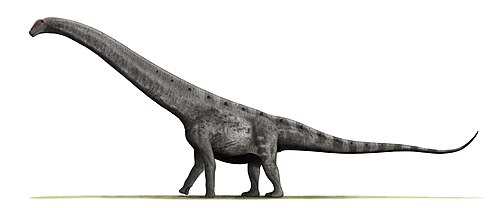
 🎨 Restoration
Hypothetical life restoration
Restoration: Nobu Tamura ( http://spinops.blogspot.com ) · CC BY 3.0 · Wikimedia Commons Source
Life restorations are artistic reconstructions based on fossil evidence; true coloration and soft-tissue details remain uncertain.
Argentinosaurus
Argentinosaurus huinculensis (Argentinosaurus · アルゼンチノサウルス)
Known only from fossils. The IUCN Red List assesses only species extant since 1500 CE, so fossil taxa are not assigned a category.
💡 Everyday Comparisons for Size, Mass & Speed
- 📏 Length 35m — ~2.9× the length of a 12 m coach bus
- 🏢 Height 7.3m — ~2.6 building stories tall (~2.8 m per floor)
- ⚖️ Mass 70t — Equivalent to ~70 compact cars (~1 t each)
- ⚡ Speed 14km/h — ~3.5× human walking speed (~4 km/h)
Reference standards: coach bus ~12 m, mid-size car ~4.9 m, compact car ~1 t, basketball hoop 3.05 m, credit card 8.56 cm.
Site-computed relative index from recorded values; not a formal scientific metric.
📖 1. Overview
Estimated at about 30–35 m in body length and about 65–75 tonnes in weight, it is one of the largest land animals ever known. Because only partial bones (such as back vertebrae and limb bones) have been found, its size is an estimate based on comparisons with close relatives.
🌐 Wikipedia Summary ExtractArgentinosaurus is a genus of giant sauropod dinosaur that lived during the Early Cretaceous period in what is now Argentina. Although it is only known from fragmentary remains, Argentinosaurus was one of the largest known land animals of all time, measuring 30–35 m (98–115 ft) long and weighing 65–80 t. It was a member of Titanosauria, the dominant group of sauropods during the Cretaceous.
🦴 2. Anatomy & Morphology
A single dorsal vertebra measures 1.59 m in height—as tall as an adult human man.
🔍 3. Fossil Record & Paleoecology
Because a newly hatched juvenile would have weighed only a few kilograms, a fully grown adult is calculated to have become more than 10,000 times heavier than at birth.
🇰🇷 4. Connection to Korea
It belongs to the Titanosauriformes, the same group as Pukyongosaurus, a sauropod from the Korean Peninsula.
📚 Sources & References
- • Wikipedia “Argentinosaurus”
- • Wikidata Q21355653
- • Fossil taxon — the IUCN Red List assesses only species living or extinct since 1500
- • nhm.ac.uk — argentinosaurus.html
- • Silhouette: PhyloPic — Ryan Santos Soledade · CC0 1.0 (Related taxon silhouette — Neuquensaurus australis)
Recorded dimensions are widely cited representative estimates from public literature and may vary by study or specimen.