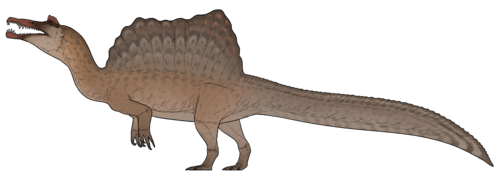
 🎨 Restoration
Life restoration
Restoration: Connor Ashbridge · CC BY 4.0 · Wikimedia Commons Source
Life restorations are artistic reconstructions based on fossil evidence; true coloration and soft-tissue details remain uncertain.
Spinosaurus
Spinosaurus aegyptiacus (Spinosaurus · スピノサウルス)
Known only from fossils. The IUCN Red List assesses only species extant since 1500 CE, so fossil taxa are not assigned a category.
💡 Everyday Comparisons for Size, Mass & Speed
- 📏 Length 14m — ~1.2× the length of a 12 m coach bus
- 🏢 Height 4.3m — ~2.5× the height of a 1.75 m human
- ⚖️ Mass 7.4t — Equivalent to ~7.4 compact cars (~1 t each)
- ⚡ Speed 24km/h — ~0.6× Usain Bolt's 100 m world-record average speed (37.6 km/h)
Reference standards: coach bus ~12 m, mid-size car ~4.9 m, compact car ~1 t, basketball hoop 3.05 m, credit card 8.56 cm.
Site-computed relative index from recorded values; not a formal scientific metric.
📖 1. Overview
Reaching up to 15 m in body length, this semiaquatic theropod was the longest of all known carnivorous dinosaurs and had a 1.65 m-tall sail rising from its back.
🌐 Wikipedia Summary ExtractSpinosaurus is a genus of large spinosaurid theropod dinosaurs that lived in what is now North Africa during the Cenomanian age of the Late Cretaceous period, about 100 to 94 million years ago. The genus was known first from Egyptian remains discovered in 1912 and described by German palaeontologist Ernst Stromer in 1915. The original remains were destroyed in World War II, but additional material came to light in the early 21st century. It is unclear whether one or two species are represented in the fossils reported in the scientific literature. The type species, S. aegyptiacus, is mainly known from the Bahariya Formation in Egypt and the Kem Kem beds in Morocco. The other species, S. mirabilis, is known from the Farak Formation in Niger. Possible junior synonyms include Sigilmassasaurus and the dubious S. maroccanus from the Kem Kem beds and Oxalaia from the Alcântara Formation in Brazil, though the distinction and validity of these taxa have been debated.
🦴 2. Anatomy & Morphology
Using pressure-sensing neurovascular foramina at the tip of its long crocodile-like snout and a vertically broad, fin-like propelling tail like a salamander's, it hunted giant fish.
🔍 3. Fossil Record & Paleoecology
Its adaptation for aquatic swimming was proven by a complete tail skeleton fossil excavated in Morocco in 2020.
🇰🇷 4. Connection to Korea
A conical tooth fossil belonging to the spinosaurid lineage was discovered in Early Cretaceous strata in Hadong-gun, Gyeongnam.
📚 Sources & References
- • Wikipedia “Spinosaurus”
- • Wikidata Q3966781
- • Fossil taxon — the IUCN Red List assesses only species living or extinct since 1500
- • nhm.ac.uk — spinosaurus.html
- • Silhouette: PhyloPic — Tasman Dixon · CC0 1.0
Recorded dimensions are widely cited representative estimates from public literature and may vary by study or specimen.