 📸 Photo
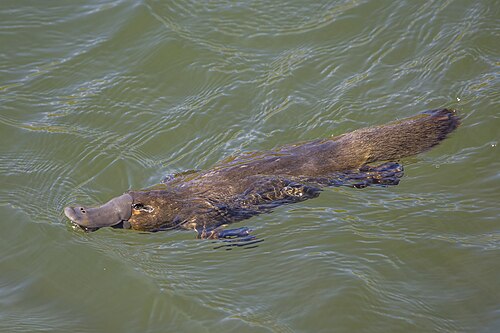
Duck-billed platypus ( Ornithorhynchus anatinus ), Scottsdale, TAS, Australia
Photo: Charles J. Sharp · CC BY-SA 4.0 · Wikimedia Commons Source
Platypus
Ornithorhynchus anatinus (Platypus · カモノハシ)
💡 Everyday Comparisons for Size, Mass & Speed
- 📏 Length 39cm — ~1.3× the long side of an A4 sheet (29.7 cm)
- ⚖️ Mass 800g — Equivalent to ~13.3 chicken eggs (~60 g each)
- ⚡ Speed 12km/h — ~3× human walking speed (~4 km/h)
Reference standards: coach bus ~12 m, mid-size car ~4.9 m, compact car ~1 t, basketball hoop 3.05 m, credit card 8.56 cm.
Site-computed relative index from recorded values; not a formal scientific metric.
📖 1. Overview
One of evolutionary biology's greatest mysteries: a mammal that lays eggs like birds or reptiles (monotreme), detects faint bioelectricity with its bill, and bears venomous spurs on the male's hind legs.
🌐 Wikipedia Summary ExtractThe platypus, sometimes referred to as the duck-billed platypus, is a semiaquatic, egg-laying mammal endemic to eastern Australia, including Tasmania. The platypus is the sole living representative of the family Ornithorhynchidae and genus Ornithorhynchus, though a number of related species appear in the fossil record. Together with the four species of echidna, it is one of the five extant species of monotremes, mammals that lay eggs instead of giving birth to live young. Like other monotremes, the platypus has a sense of electrolocation, which it uses to detect prey in water while its eyes, ears and nostrils are closed. It is one of the few species of venomous mammals, as the male platypus has a spur on each hind foot that delivers an extremely painful venom.
🦴 2. Anatomy & Morphology
Closing its eyes, ears, and nostrils underwater, it hunts by detecting the muscle contraction currents of riverbed shrimp using only the 40,000 electroreceptors on its duck-like bill.
🔍 3. Ecology & Behavior
It feeds its newly hatched young with milk that oozes directly from its abdominal skin without nipples, and its fur glows with cyan biofluorescence under ultraviolet (UV) light.
🇰🇷 4. Connection to Korea
It is a living fossil of genomic evolution, bridging reptile-like ancestors and modern mammals.
📚 Sources & References
- • Wikipedia “Platypus”
- • Wikidata Q15343
- • IUCN Red List category NT — latest assessment at iucnredlist.org
- • animaldiversity.org — Ornithorhynchus anatinus
- • Silhouette: PhyloPic — Rachel T Mason · CC0 1.0
Recorded dimensions are widely cited representative estimates from public literature and may vary by study or specimen.