 📸 Photo
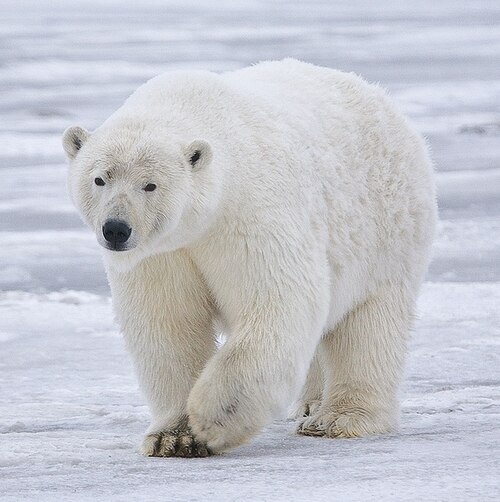
Female polar bear ( Ursus maritimus ) near Kaktovik , Barter Island , Alaska .
Photo: Alan Wilson · CC BY-SA 3.0 · Wikimedia Commons Source
Polar Bear
Ursus maritimus (Polar Bear · ホッキョクグマ)
💡 Everyday Comparisons for Size, Mass & Speed
- 📏 Length 2.5m — ~1.4× the height of a 1.75 m adult human
- 🏢 Height 1.5m — ~0.9× the height of a 1.75 m human
- ⚖️ Mass 300kg — ~4.3× the mass of a 70 kg adult human
- ⚡ Speed 40km/h — ~1.1× Usain Bolt's 100 m world-record average speed (37.6 km/h)
Reference standards: coach bus ~12 m, mid-size car ~4.9 m, compact car ~1 t, basketball hoop 3.05 m, credit card 8.56 cm.
Site-computed relative index from recorded values; not a formal scientific metric.
📖 1. Overview
The largest terrestrial carnivoran predator with the heaviest average body weight, whose scientific name Ursus maritimus means 'sea bear.'
🌐 Wikipedia Summary ExtractThe polar bear is a large bear native to the Arctic and nearby areas. It is closely related to the brown bear, and the two species can interbreed. The polar bear is the largest extant species of bear and land carnivore by body mass, with adult males weighing 300–800 kg (660–1,760 lb). The species is sexually dimorphic, as adult females are much smaller. The polar bear is white or yellowish-furred with black skin and a thick layer of fat. It is more slender than the brown bear, with a narrower skull, longer neck and lower shoulder hump. Its teeth are sharper and more adapted to cutting meat. The paws are large and allow the bear to walk on ice and paddle in the water.
🦴 2. Anatomy & Morphology
With hollow transparent tubular hairs, black skin, and an 11 cm thick blubber layer, it perfectly maintains its body temperature even in the icy waters of the Arctic Ocean.
🔍 3. Ecology & Behavior
It possesses an ultra-sensitive sense of smell capable of detecting seal breathing holes beneath the ice from 1.5 km away.
🇰🇷 4. Connection to Korea
It is a representative indicator species for climate change ecological research at the Korea Polar Research Institute (KOPRI) Arctic Dasan Station.
📚 Sources & References
- • Wikipedia “Polar bear”
- • Wikidata Q33609
- • IUCN Red List category VU — latest assessment at iucnredlist.org
- • animaldiversity.org — Ursus maritimus
- • Silhouette: PhyloPic — Margot Michaud · CC0 1.0
Recorded dimensions are widely cited representative estimates from public literature and may vary by study or specimen.