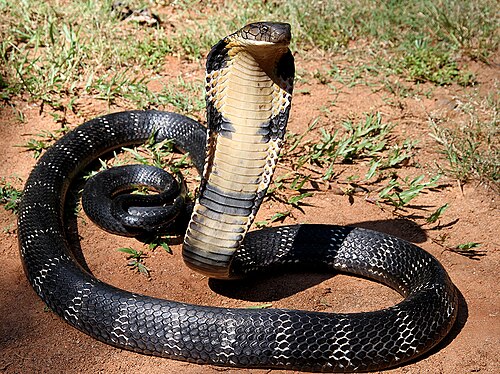
 📸 Photo
Photo by Dr. Anand Titus and Geeta N Pereira ( [1] )
Photo: Michael Allen Smith from Seattle, USA · CC BY-SA 2.0 · Wikimedia Commons Source
King Cobra
Ophiophagus hannah (King Cobra · キングコブラ)
💡 Everyday Comparisons for Size, Mass & Speed
- 📏 Length 5.4m — ~1.1× the length of a mid-size sedan (4.9 m)
- 🏢 Height 1.5m — ~0.9× the height of a 1.75 m human
- ⚖️ Mass 9kg — Equivalent to ~4.5 two-liter water bottles (2 kg each)
- ⚡ Speed 18km/h — ~4.5× human walking speed (~4 km/h)
Reference standards: coach bus ~12 m, mid-size car ~4.9 m, compact car ~1 t, basketball hoop 3.05 m, credit card 8.56 cm.
Site-computed relative index from recorded values; not a formal scientific metric.
📖 1. Overview
Reaching up to 5.5 m in length, it is the world's longest venomous snake. Its generic name Ophiophagus means 'snake-eater,' and it feeds primarily on other snakes.
🌐 Wikipedia Summary ExtractThe king cobra is a species complex of snakes endemic to Asia. With an average length of 3.18 to 4 m and a record length of 5.85 m (19.2 ft), it is the world's longest venomous snake and among the heaviest. Under the genus Ophiophagus, it is not phylogenetically a true cobra despite its common name and some resemblance. Spanning from the Indian subcontinent through Southeastern Asia to Southern China, the king cobra is widely distributed albeit not commonly seen.
🦴 2. Anatomy & Morphology
It can rear up one-third of its body (to an adult chest height of 1.5 m) and spread its neck ribs to form a hood, delivering enough neurotoxin in a single bite to bring down an elephant.
🔍 3. Ecology & Behavior
Unique among snakes, the female displays maternal care by gathering fallen leaves to build a two-chambered egg nest and guarding it until hatching.
🇰🇷 4. Connection to Korea
It is a core species for neurotoxin pharmacology and antivenom medical research.
📚 Sources & References
- • Wikipedia “King cobra”
- • Wikidata Q48186
- • IUCN Red List category VU — latest assessment at iucnredlist.org
- • nationalzoo.si.edu — king-cobra
- • Silhouette: PhyloPic — V. Deepak · CC BY 3.0
Recorded dimensions are widely cited representative estimates from public literature and may vary by study or specimen.