 🎨 Restoration
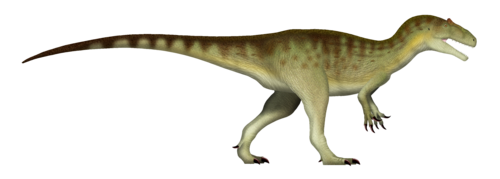
Life restoration of A. jimmadseni
Restoration: TotalDino · CC BY 4.0 · Wikimedia Commons Source
Life restorations are artistic reconstructions based on fossil evidence; true coloration and soft-tissue details remain uncertain.
Allosaurus
Allosaurus fragilis (Allosaurus · アロサウルス)
Known only from fossils. The IUCN Red List assesses only species extant since 1500 CE, so fossil taxa are not assigned a category.
💡 Everyday Comparisons for Size, Mass & Speed
- 📏 Length 9.7m — ~2× the length of a mid-size sedan (4.9 m)
- 🏢 Height 3.2m — ~1.8× the height of a 1.75 m human
- ⚖️ Mass 2.3t — Equivalent to ~2.3 compact cars (~1 t each)
- ⚡ Speed 34km/h — ~0.9× Usain Bolt's 100 m world-record average speed (37.6 km/h)
Reference standards: coach bus ~12 m, mid-size car ~4.9 m, compact car ~1 t, basketball hoop 3.05 m, credit card 8.56 cm.
Site-computed relative index from recorded values; not a formal scientific metric.
📖 1. Overview
As the apex predator of Late Jurassic North American ecosystems, it is called the 'Lion of the Jurassic.'
🌐 Wikipedia Summary ExtractAllosaurus is a genus of theropod dinosaur that lived 155 to 143 million years ago during the late Jurassic period. The first fossil remains that could definitively be ascribed to this genus were described in 1877 by Othniel C. Marsh. The name "Allosaurus" means "different lizard", alluding to its lightweight vertebrae, which Marsh believed were unique. The genus has a very complicated taxonomy and includes at least three valid species, the best known of which is A. fragilis. The bulk of Allosaurus remains come from North America's Morrison Formation, with material also known from the Alcobaça, Bombarral, and Lourinhã formations in Portugal. It was known for over half of the 20th century as Antrodemus, but a study of the abundant remains from the Cleveland-Lloyd Dinosaur Quarry returned the name "Allosaurus" to prominence. As one of the first well-known theropod dinosaurs, it has long attracted attention outside of paleontological circles.
🦴 2. Anatomy & Morphology
It used a hatchet-like striking hunting method—opening its jaws nearly 90 degrees to slash downward—along with powerful three-clawed forelimbs.
🔍 3. Fossil Record & Paleoecology
Numerous fossils bearing evidence of fierce battles with Stegosaurus have been discovered.
🇰🇷 4. Connection to Korea
It is a flagship skeleton exhibit at major natural history museums in Korea, including the Gwacheon National Science Museum.
📚 Sources & References
- • Wikipedia “Allosaurus”
- • Wikidata Q20716974
- • Fossil taxon — the IUCN Red List assesses only species living or extinct since 1500
- • nhm.ac.uk — allosaurus.html
- • Silhouette: PhyloPic — Will Toosey · CC BY 4.0
Recorded dimensions are widely cited representative estimates from public literature and may vary by study or specimen.