 🎨 Restoration
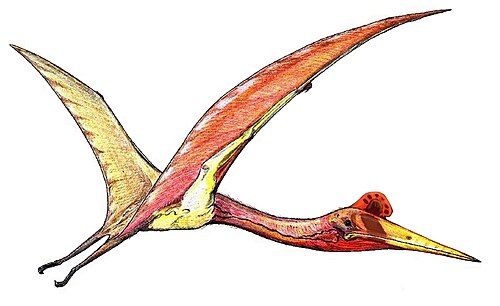
Restoration of a Quetzalcoatlus in flight
Restoration: ДиБгд at Russian Wikipedia · Public domain · Wikimedia Commons Source
Life restorations are artistic reconstructions based on fossil evidence; true coloration and soft-tissue details remain uncertain.
Quetzalcoatlus
Quetzalcoatlus northropi (Quetzalcoatlus · ケツァルコアトルス)
Known only from fossils. The IUCN Red List assesses only species extant since 1500 CE, so fossil taxa are not assigned a category.
💡 Everyday Comparisons for Size, Mass & Speed
- 🪽 Wingspan 11m — Wingspan is ~6.3× the height of a 1.75 m human
- 🏢 Height 5.2m — ~3× the height of a 1.75 m human
- ⚖️ Mass 220kg — ~3.1× the mass of a 70 kg adult human
- ⚡ Speed 110km/h — ~1.1× highway speed limit (100 km/h)
Reference standards: coach bus ~12 m, mid-size car ~4.9 m, compact car ~1 t, basketball hoop 3.05 m, credit card 8.56 cm.
Site-computed relative index from recorded values; not a formal scientific metric.
📖 1. Overview
With an estimated wingspan of about 10–11 m and a standing height of about 5 m—similar to a giraffe—it is one of the largest flying animals ever known.
🌐 Wikipedia Summary ExtractQuetzalcoatlus is a genus of azhdarchid pterosaur that lived during the Maastrichtian age of the Late Cretaceous in North America. The type specimen, recovered in 1971 from the Javelina Formation of Texas, United States, consists of several wing fragments and was described as Quetzalcoatlus northropi in 1975 by Douglas Lawson. The generic name refers to the Aztec serpent god of the sky, Quetzalcōātl, while the specific name honors Jack Northrop, designer of a tailless fixed-wing aircraft. The remains of a second species were found between 1972 and 1974, also by Lawson, around 40 km (25 mi) from the Q. northropi locality. In 2021, these remains were assigned to the name Quetzalcoatlus lawsoni by Brian Andres and (posthumously) Wann Langston Jr., as part of a series of publications on the genus.
🦴 2. Anatomy & Morphology
The leading hypothesis is that it walked on all fours on the ground, caught small animals with its long beak, and launched itself into the air by vaulting off the ground with its forelimbs.
🔍 3. Fossil Record & Paleoecology
It is a pterosaur that shows the most striking scale contrast when placed next to an adult human (1.75 m).
🇰🇷 4. Connection to Korea
It belongs to the same family, Azhdarchidae, as the "Haenamichnus" pterosaur trackway fossils from the southern coast of the Korean Peninsula.
📚 Sources & References
- • Wikipedia “Quetzalcoatlus”
- • Wikidata Q20719201
- • Fossil taxon — the IUCN Red List assesses only species living or extinct since 1500
- • nhm.ac.uk — largest-ever-flying-animal-behaved-like-giant-heron.html
- • Silhouette: PhyloPic — jack liddle · CC BY 4.0
Recorded dimensions are widely cited representative estimates from public literature and may vary by study or specimen.