 🎨 Restoration
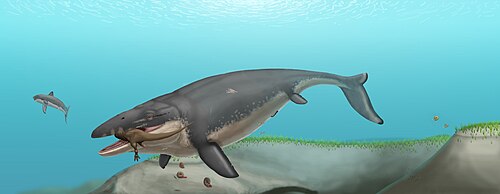
Life restoration of M. hoffmanni
Restoration: Jonagold2000 · CC BY-SA 4.0 · Wikimedia Commons Source
Life restorations are artistic reconstructions based on fossil evidence; true coloration and soft-tissue details remain uncertain.
Mosasaurus
Mosasaurus hoffmannii (Mosasaurus · モササウルス)
Known only from fossils. The IUCN Red List assesses only species extant since 1500 CE, so fossil taxa are not assigned a category.
💡 Everyday Comparisons for Size, Mass & Speed
- 📏 Length 17m — ~1.4× the length of a 12 m coach bus
- 🏢 Height 2.8m — ~1.6× the height of a 1.75 m human
- ⚖️ Mass 10t — Equivalent to ~10 compact cars (~1 t each)
- ⚡ Speed 45km/h — ~1.2× Usain Bolt's 100 m world-record average speed (37.6 km/h)
Reference standards: coach bus ~12 m, mid-size car ~4.9 m, compact car ~1 t, basketball hoop 3.05 m, credit card 8.56 cm.
Site-computed relative index from recorded values; not a formal scientific metric.
📖 1. Overview
An apex marine reptile that ruled the seas at the end of the Cretaceous, and a giant marine relative of modern monitor lizards and snakes (order Squamata).
🌐 Wikipedia Summary ExtractMosasaurus is the type genus of the Mosasauridae, an extinct group of aquatic squamate reptiles. It lived from about 82 to 66 million years ago during the Campanian and Maastrichtian stages of the Late Cretaceous. The genus was one of the first Mesozoic marine reptiles known to science—the first fossils of Mosasaurus were found as skulls in a chalk quarry near the Dutch city of Maastricht in the late 18th century, and were initially thought to be crocodiles or whales. One skull discovered in 1778 was famously nicknamed the "great animal of Maastricht". In 1808, naturalist Georges Cuvier concluded that it belonged to a giant marine lizard with similarities to monitor lizards but otherwise unlike any known living animal. This concept was revolutionary at the time and helped support the then-developing ideas of extinction. Cuvier did not designate a scientific name for the animal; this was done by William Daniel Conybeare in 1822 when he named it Mosasaurus in reference to its origin in fossil deposits near the Meuse River. The exact affinities of Mosasaurus as a squamate remain controversial, and scientists continue to debate whether its closest living relatives are monitor lizards or snakes.
🦴 2. Anatomy & Morphology
A second row of teeth (pterygoid teeth) grew on the roof of its mouth (pterygoid bone), ensuring that prey once bitten could never escape.
🔍 3. Fossil Record & Paleoecology
Discovered in Maastricht, the Netherlands in 1764, it is a historic fossil that helped establish the concept of "extinction" for humanity.
🇰🇷 4. Connection to Korea
It was an apex predator of the circum-Pacific Cretaceous marine ecosystem.
📚 Sources & References
- • Wikipedia “Mosasaurus”
- • Wikidata Q312131
- • Fossil taxon — the IUCN Red List assesses only species living or extinct since 1500
- • nhm.ac.uk — what-is-a-mosasaur.html
- • Silhouette: PhyloPic — Cy Marchant · CC BY 4.0 (Related taxon silhouette — Jormungandr walhallaensis)
Recorded dimensions are widely cited representative estimates from public literature and may vary by study or specimen.