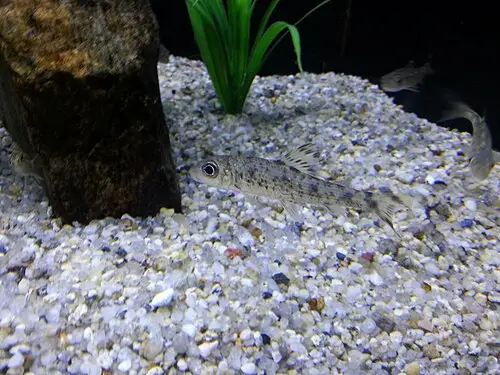
 📸 Photo
Photo: 종현 · CC BY-SA 3.0 · Wikimedia Commons Source
Spotted barbel
Hemibarbus mylodon (Spotted barbel · ヤガタニゴイ)
Not Evaluated (NE) on the IUCN Red List yet.
🇰🇷 Class II endangered wildlife (Korea) · Natural Monument (Korea) «Spotted barbel»
💡 Everyday Comparisons for Size, Mass & Speed
- 💡 A body length of 30 cm is similar to a single 30 cm student ruler (Comparison).
- 💡 The spawning mound measures 40 to 58 cm long and 22 to 35 cm wide, a pile of gravel roughly the size of two A4 sheets placed side by side (Comparison).
- 💡 It is a freshwater fish designated as a Natural Monument (Korea) and protected by the state (Korea Heritage Service).
Reference standards: coach bus ~12 m, mid-size car ~4.9 m, compact car ~1 t, basketball hoop 3.05 m, credit card 8.56 cm.
📖 1. Overview
The spotted barbel is a freshwater cyprinid fish found only in the Han, Imjin, and Geum Rivers, notable for the rows of black spots along the sides of its body.
🦴 2. Anatomy & Morphology
The body is nearly cylindrical and tapers toward the rear, with a long snout and one pair of long barbels. Small spots run along the sides in 7 to 8 rows.
🔍 3. Ecology & Behavior
It feeds on aquatic insects and freshwater snails, and in April and May it exhibits the distinctive habit of digging a pit in the riverbed, laying eggs, and carrying fine gravel in its mouth to build a spawning mound.
🇰🇷 4. Connection to Korea
It is designated as Class II endangered wildlife (Korea) and became a Natural Monument (Korea) on August 22, 1978, and is a Korean endemic species inhabiting the Han, Imjin, and Geum Rivers.
📚 Sources & References
- • 멸종위기 야생생물 Ⅱ급 · 천연기념물 «어름치» — 국가생물종목록(국립생물자원관) ktsn 120000057572 — https://species.nibr.go.kr/home/mainHome.do?cont_link=009&subMenu=009002&contCd=009002&ktsn=120000057572
- • IUCN Red List: not evaluated (NE) — cross-checked with the Wikidata conservation-status entry
- • Korean protection status: Class II endangered wildlife (Korea) · Natural Monument (Korea) «Spotted barbel»
- • catalogueoflife.org — 3KLQB
- • 국가생물종목록(국립생물자원관) ktsn 120000057572 — https://species.nibr.go.kr/home/mainHome.do?cont_link=009&subMenu=009002&contCd=009002&ktsn=120000057572
- • heritage.go.kr — culSelectDetail.do
- • wikidata.org — Q484597
- • commons.wikimedia.org — File:Eoreumchi.jpg
- • species.nibr.go.kr — list
- • fishbase.se — Hemibarbus-mylodon.html
- • Silhouette: PhyloPic — Douglas Teles da Rosa · CC0 1.0 (Related taxon silhouette — Tanichthys albonubes)
Recorded dimensions are widely cited representative estimates from public literature and may vary by study or specimen.