 🎨 Restoration
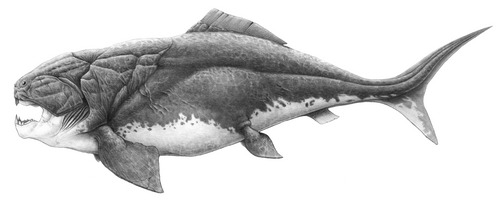
Palaeoartistic reconstruction of a 8.79 meters D. terrelli (courtesy of Hugo Salais, HS Scientific Illustration).
Restoration: Hugo Salais · CC BY 4.0 · Wikimedia Commons Source
Life restorations are artistic reconstructions based on fossil evidence; true coloration and soft-tissue details remain uncertain.
Dunkleosteus
Dunkleosteus terrelli (Dunkleosteus · ダンクルオステウス)
Known only from fossils. The IUCN Red List assesses only species extant since 1500 CE, so fossil taxa are not assigned a category.
💡 Everyday Comparisons for Size, Mass & Speed
- 📏 Length 4m — ~2.3× the height of a 1.75 m adult human
- 🏢 Height 1.6m — ~0.9× the height of a 1.75 m human
- ⚖️ Mass 1.5t — ~21.4× the mass of a 70 kg adult human
- ⚡ Speed 30km/h — ~0.8× Usain Bolt's 100 m world-record average speed (37.6 km/h)
Reference standards: coach bus ~12 m, mid-size car ~4.9 m, compact car ~1 t, basketball hoop 3.05 m, credit card 8.56 cm.
Site-computed relative index from recorded values; not a formal scientific metric.
📖 1. Overview
An apex placoderm (armored fish) predator that ruled the Devonian seas during the "Age of Fishes." Although often cited at 5–10 m, a 2023 study (Engelman) re-estimated typical adults at about 3.4 m and the largest individuals at about 4.1 m.
🌐 Wikipedia Summary ExtractDunkleosteus is an extinct genus of large arthrodire ("jointed-neck") fish that existed during the Late Devonian period, about 382–358 million years ago. It was a pelagic fish inhabiting open waters, and one of the first vertebrate apex predators of any ecosystem. Fossils of Dunkleosteus have been found in the United States, Canada, Poland, Belgium, Morocco, and Russia.
🦴 2. Anatomy & Morphology
Its jawbones themselves evolved like shear blades, slicing other armored fishes in two.
🔍 3. Fossil Record & Paleoecology
It is regarded as the first marine superpredator in vertebrate history.
🇰🇷 4. Connection to Korea
It is a key prehistoric animal for explaining the evolution of jawed fishes (gnathostomes).
📚 Sources & References
- • Engelman, R. K. (2023). A Devonian Fish Tale: A New Method of Body Length Estimation Suggests Much Smaller Sizes for Dunkleosteus terrelli (Placodermi: Arthrodira). Diversity 15(3): 318. https://doi.org/10.3390/d15030318 — about 3.4 m for typical adults, up to about 4.1 m for the largest known individuals (length only)
- • Wikipedia “Dunkleosteus”
- • Wikidata Q911593
- • Fossil taxon — the IUCN Red List assesses only species living or extinct since 1500
- • dam.assets.ohio.gov — GF35 Dunkleosteus Peter 2025.pdf
- • Silhouette: PhyloPic — Jagged Fang Designs · CC0 1.0
Recorded dimensions are widely cited representative estimates from public literature and may vary by study or specimen.