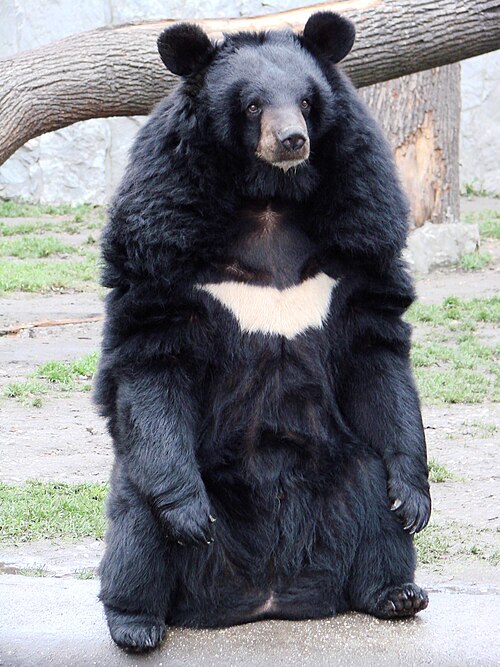
 📸 Photo
Animal species: Asiatic Black Bear ( Wrocław zoo)
Photo: Guérin Nicolas ( messages ) · CC BY-SA 3.0 · Wikimedia Commons Source
Asiatic Black Bear
Ursus thibetanus ussuricus (Asiatic Black Bear · ツキノワグマ)
💡 Everyday Comparisons for Size, Mass & Speed
- 📏 Length 1.38m — ~0.8× the height of a 1.75 m adult human
- ⚖️ Mass 80kg — ~1.1× the mass of a 70 kg adult human
- ⚡ Speed 48km/h — ~1.3× Usain Bolt's 100 m world-record average speed (37.6 km/h)
Reference standards: coach bus ~12 m, mid-size car ~4.9 m, compact car ~1 t, basketball hoop 3.05 m, credit card 8.56 cm.
Site-computed relative index from recorded values; not a formal scientific metric.
📖 1. Overview
A representative large mammal of Korea's Baekdudaegan mountain range with a distinct white crescent (V-shaped) mark on its chest, designated as Natural Monument (Korea) No. 329 and Class I endangered wildlife (Korea).
🌐 Wikipedia Summary ExtractThe Asian black bear, also known as the Asiatic black bear, moon bear and white-chested bear, is a medium-sized bear species native to Asia that is largely adapted to an arboreal lifestyle. It is distributed from southeastern Iran, Pakistan, India and the Himalayas to mainland Southeast Asia, the Korean Peninsula, Taiwan, China and the Russian Far East to the islands of Honshū and Shikoku in Japan. It is listed as vulnerable on the IUCN Red List, and is threatened by deforestation and poaching for its body parts, which are used in traditional medicine.
🦴 2. Anatomy & Morphology
With curved claws well-suited for climbing trees, it climbs to the tops of oak trees to eat acorns and wild berries, breaking branches to build 'bear nests.'
🔍 3. Ecology & Behavior
By eating and excreting seeds, it disperses seeds across forest ecosystems and serves as the 'gardener of the forest' (an umbrella species).
🇰🇷 4. Connection to Korea
Through the species restoration project in Jirisan National Park, over 80 individuals have now successfully settled in the wild.
📚 Sources & References
- • Wikipedia “Asian black bear”
- • Wikidata Q124410
- • IUCN Red List category VU — latest assessment at iucnredlist.org
- • nie.re.kr — view.do
- • Silhouette: PhyloPic — Tracy A. Heath · CC0 1.0
Recorded dimensions are widely cited representative estimates from public literature and may vary by study or specimen.