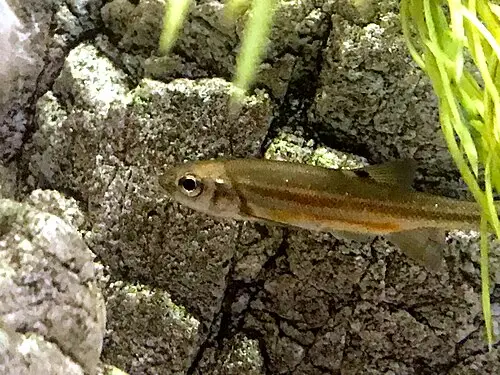
 📸 Photo
Photo: Gaeho77 · CC BY-SA 4.0 · Wikimedia Commons Source
Kumgang fat minnow
Rhynchocypris kumgangensis (Kumgang fat minnow · コンゴウハヤ)
Not Evaluated (NE) on the IUCN Red List yet.
💡 Everyday Comparisons for Size, Mass & Speed
- 💡 Its maximum total length of 8 cm is slightly shorter than the width of a credit card (about 8.6 cm) (Comparison).
- 💡 It grows to 5 cm in body length in 1 year and 7–8 cm in 2 years (National List of Species of Korea).
- 💡 It can only be seen in clear mountain valleys such as the uppermost Han River and Muju Gucheondong (National List of Species of Korea).
Reference standards: coach bus ~12 m, mid-size car ~4.9 m, compact car ~1 t, basketball hoop 3.05 m, credit card 8.56 cm.
📖 1. Overview
The Kumgang fat minnow is a small fish endemic to the Korean Peninsula that lives in schools in clear, cold mountain streams. It inhabits waters that stay at or below 25 °C even in midsummer.
🦴 2. Anatomy & Morphology
Its body is long and laterally flattened, with the mouth positioned under the front of the snout. The back is yellowish-brown, the belly is silvery-white, there is a black spot on the dorsal fin, and spawning males develop two bright orange stripes along the middle of the body.
🔍 3. Ecology & Behavior
It preys on aquatic insects and small crustaceans. In April and May, hundreds gather and burrow into gravel beds to spawn, and fertilized eggs hatch after 5 days at 16 °C.
🇰🇷 4. Connection to Korea
It is an endemic species on the National List of Species of Korea, recorded in Gyeonggi-do, Gangwon-do, and Jeollabuk-do (the uppermost reaches of the Han River and Muju Gucheondong of the Geum River).
📚 Sources & References
- • IUCN Red List: not evaluated (NE) — cross-checked with the Wikidata conservation-status entry
- • catalogueoflife.org — 4GTFW
- • 국가생물종목록(국립생물자원관) ktsn 120000057617 — https://species.nibr.go.kr/home/mainHome.do?cont_link=009&subMenu=009002&contCd=009002&ktsn=120000057617
- • wikidata.org — Q3761116
- • commons.wikimedia.org — File:Phoxinus kumgangensis, Danyang.jpg
- • fishbase.se — Rhynchocypris-kumgangensis.html
- • species.nibr.go.kr — mainHome.do
- • Silhouette: PhyloPic — Carlos Cano-Barbacil · CC0 1.0 (Related taxon silhouette — Luciobarbus graellsii)
Recorded dimensions are widely cited representative estimates from public literature and may vary by study or specimen.