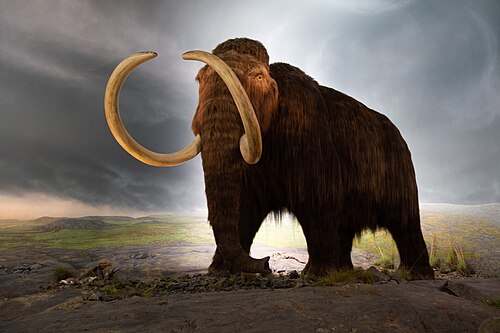
 🎨 Restoration
Model at the Royal BC Museum
Restoration: Thomas Quine · CC BY 2.0 · Wikimedia Commons Source
Life restorations are artistic reconstructions based on fossil evidence; true coloration and soft-tissue details remain uncertain.
Woolly Mammoth
Mammuthus primigenius (Woolly Mammoth · ケナガマンモス)
Known only from fossils. The IUCN Red List assesses only species extant since 1500 CE, so fossil taxa are not assigned a category.
💡 Everyday Comparisons for Size, Mass & Speed
- 📏 Length 6.5m — ~1.3× the length of a mid-size sedan (4.9 m)
- 🏢 Height 3.35m — ~1.9× the height of a 1.75 m human
- ⚖️ Mass 5.4t — Equivalent to ~5.4 compact cars (~1 t each)
- ⚡ Speed 35km/h — ~0.9× Usain Bolt's 100 m world-record average speed (37.6 km/h)
Reference standards: coach bus ~12 m, mid-size car ~4.9 m, compact car ~1 t, basketball hoop 3.05 m, credit card 8.56 cm.
Site-computed relative index from recorded values; not a formal scientific metric.
📖 1. Overview
A representative Cenozoic giant proboscidean mammal that endured the extreme cold of the Ice Age with curved tusks up to 4.2 m long and a thick coat of long hair.
🌐 Wikipedia Summary ExtractThe woolly mammoth is an extinct species of mammoth that lived from the Middle Pleistocene until its extinction in the Holocene epoch. It was one of the last in a line of mammoth species, beginning with the African Mammuthus subplanifrons in the early Pliocene. The woolly mammoth began to diverge from the steppe mammoth about 800,000 years ago in Siberia. Its closest extant relative is the Asian elephant. The Columbian mammoth lived alongside the woolly mammoth in North America, and DNA studies show that the two hybridised with each other. Mammoth remains were long known in Asia before they became known to Europeans. The origin of these remains was long debated and often explained as the remains of legendary creatures. The mammoth was identified as an extinct elephant species by Georges Cuvier in 1796.
🦴 2. Anatomy & Morphology
It evolved small ears that reduced heat loss and hemoglobin proteins specialized for delivering oxygen at low temperatures.
🔍 3. Fossil Record & Paleoecology
Its entire genome has been sequenced from frozen specimens preserved in the Siberian permafrost.
🇰🇷 4. Connection to Korea
Woolly mammoth molar and tusk fossils have been unearthed in Gilju-gun (Hamgyongbuk-do), on the seabed of the East Sea, and in Buan (Jeollabuk-do).
📚 Sources & References
- • Wikipedia “Woolly mammoth”
- • Wikidata Q3699044
- • Fossil taxon — the IUCN Red List assesses only species living or extinct since 1500
- • nhmu.utah.edu — mammoths-and-mastodons-made-great-ice-age-team
- • Silhouette: PhyloPic — artrociraptor · CC0 1.0
Recorded dimensions are widely cited representative estimates from public literature and may vary by study or specimen.