 🦴 Fossil
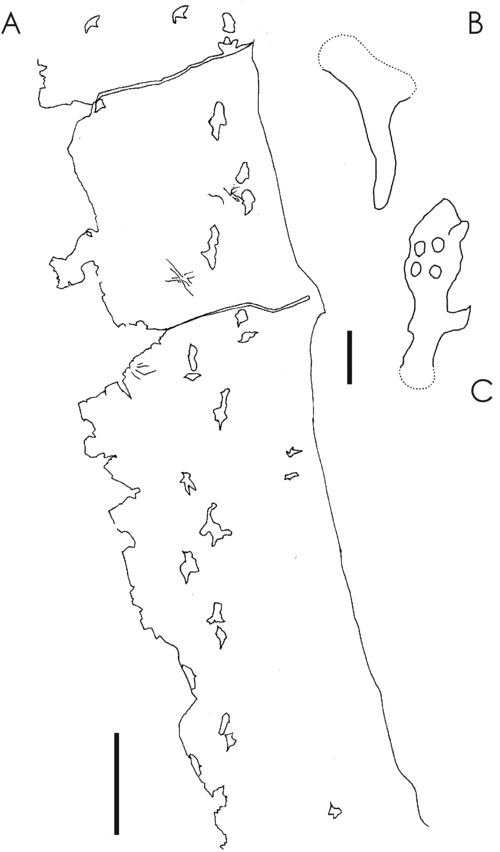
The probable azhdarchid trace fossil Haenamichnus uhangriensis . A, the 7.3 m trackway CNUPH.P9; B, H. uhangriensis holotype (CNUPH.P2), manus (top) and pes (bottom) prints. Scale bars represent 1 m (
Photo: Mark Witton and Darren Naish · CC BY 3.0 · Wikimedia Commons Source
Haenamichnus uhangriensis
Haenamichnus uhangriensis (Haenamichnus uhangriensis · ヘナムイクヌス)
Known only from fossils. The IUCN Red List assesses only species extant since 1500 CE, so fossil taxa are not assigned a category.
💡 Everyday Comparisons for Size, Mass & Speed
- 🦶 35cm — ~1.2× the long side of an A4 sheet (29.7 cm)
- 👣 7.3m — ~1.5× the length of a mid-size sedan (4.9 m)
Reference standards: coach bus ~12 m, mid-size car ~4.9 m, compact car ~1 t, basketball hoop 3.05 m, credit card 8.56 cm.
📖 1. Overview
The scientific name (ichnotaxon) given to pterosaur footprint fossils discovered in Uhang-ri, Haenam, Jeollanam-do. The largest footprint is about 35 cm long, making it the largest known pterosaur footprint at the time of discovery. Because only footprints—not bones—are preserved, its body length, wingspan, body mass, and speed cannot be determined.
🌐 Wikipedia Summary ExtractHaenamichnus is an ichnogenus of probable azhdarchid pterosaurs from the Late Cretaceous (Campanian) of South Korea. The type and only ichnospecies is H. uhangriensis, representing the largest known trace fossil made by a pterosaur.
🦴 2. Anatomy & Morphology
A trackway of alternating forelimb (hand) and hindlimb footprints extending over 7.3 m is preserved, showing that large pterosaurs walked on all fours on the ground. Judging from the footprint size, they are interpreted as having been left by a large pterosaur such as an azhdarchid.
🔍 3. Fossil Record & Paleoecology
A representative fossil of the Haenam Uhang-ri Dinosaur, Pterosaur, and Bird Footprint Fossil Site (Natural Monument (Korea) No. 394), it is an ichnofossil named solely from footprints without any body bones.
🇰🇷 4. Connection to Korea
Uhang-ri, Haenam is a fossil site where dinosaur, pterosaur, and waterfowl footprints occur together in the same stratum, and the actual footprints can be viewed inside the on-site protective pavilions.
📚 Sources & References
- • Hwang, K.-G. et al. (2002). New pterosaur tracks (Pteraichnidae) from the Late Cretaceous Uhangri Formation, southwestern Korea. Geological Magazine 139(4) — description of Haenamichnus uhangriensis
- • Wikipedia “Haenamichnus”
- • Wikidata Q141630570
- • Fossil taxon — the IUCN Red List assesses only species living or extinct since 1500
Recorded dimensions are widely cited representative estimates from public literature and may vary by study or specimen.