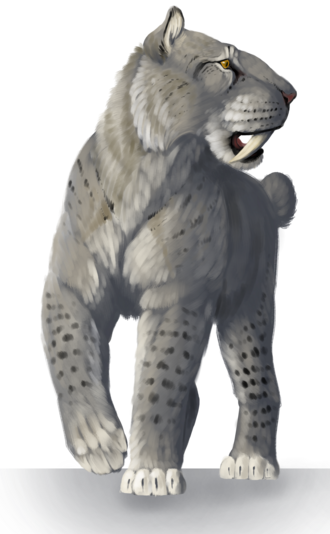
 🎨 Restoration
Smilodon fatalis. NPS illustration by Benji Paysnoe.
Restoration: NPS illustration by Benji Paysnoe · Public domain · Wikimedia Commons Source
Life restorations are artistic reconstructions based on fossil evidence; true coloration and soft-tissue details remain uncertain.
Smilodon (Saber-toothed Cat)
Smilodon fatalis (Smilodon (Saber-toothed Cat) · スミロドン (サーベルタイガー))
Known only from fossils. The IUCN Red List assesses only species extant since 1500 CE, so fossil taxa are not assigned a category.
💡 Everyday Comparisons for Size, Mass & Speed
- 📏 Length 1.75m — ~1× the height of a 1.75 m adult human
- ⚖️ Mass 280kg — ~4× the mass of a 70 kg adult human
- ⚡ Speed 48km/h — ~1.3× Usain Bolt's 100 m world-record average speed (37.6 km/h)
Reference standards: coach bus ~12 m, mid-size car ~4.9 m, compact car ~1 t, basketball hoop 3.05 m, credit card 8.56 cm.
Site-computed relative index from recorded values; not a formal scientific metric.
📖 1. Overview
A large Cenozoic felid predator of the Americas with dagger-like upper canines. Measuring about 1.75 m in body length and about 1 m in shoulder height, it was similar in size to a modern lion but had a much stockier build. (In S. populator, the largest species of the same genus, the canines grew up to about 28 cm.)
🌐 Wikipedia Summary ExtractSmilodon is a genus of extinct felids. It is one of the best-known saber-toothed predators and prehistoric mammals. Although commonly known as the saber-toothed tiger, it was not closely related to the tiger or other modern cats, belonging to the extinct subfamily Machairodontinae, with an estimated date of divergence from the ancestor of living cats around 20 million years ago. Smilodon was one of the last surviving machairodonts alongside Homotherium. Smilodon lived in the Americas during the Pleistocene to early Holocene epoch. The genus was named in 1842 based on fossils from Brazil; the generic name means 'scalpel' or 'two-edged knife' combined with 'tooth'. Three species are recognized today: S. gracilis, S. fatalis, and S. populator. The two latter species were probably descended from S. gracilis, which itself probably evolved from Megantereon. The hundreds of specimens obtained from the La Brea Tar Pits in Los Angeles constitute the largest collection of Smilodon fossils.
🦴 2. Anatomy & Morphology
After pinning down large herbivores with its bear-like, muscular forelimbs, it opened its jaws up to 120 degrees to sever the carotid artery.
🔍 3. Fossil Record & Paleoecology
With bones from more than 2,000 individuals excavated from the La Brea Tar Pits in Los Angeles, USA, it is one of the best-studied fossil mammals.
🇰🇷 4. Connection to Korea
It is a key fossil species in studying the evolution of Cenozoic carnivoran predators.
📚 Sources & References
- • Wikipedia “Smilodon”
- • Wikidata Q1956565
- • Fossil taxon — the IUCN Red List assesses only species living or extinct since 1500
- • sdnhm.org — sabertooth-cat
- • Silhouette: PhyloPic — artrociraptor · CC0 1.0
Recorded dimensions are widely cited representative estimates from public literature and may vary by study or specimen.