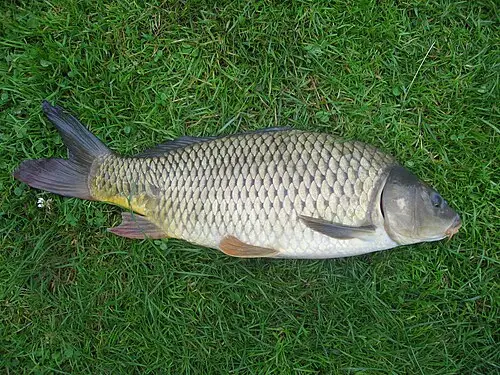
 📸 Photo
Photo: Dezidor · CC BY-SA 3.0 · Wikimedia Commons Source
Common carp
Cyprinus carpio (Common carp · コイ)
💡 Everyday Comparisons for Size, Mass & Speed
- 💡 Its maximum total length of 129 cm is slightly taller than a lower-grade elementary school child (Comparison).
- 💡 Its maximum weight of 40.1 kg equals the weight of 2 bags of rice weighing 20 kg each (Comparison).
- 💡 It is an important food fish across most of the world, with an annual catch exceeding 200,000 tons (ADW).
- 💡 Colorful varieties known as fancy carp (koi) are bred and sold as ornamental pond fish (ADW).
Reference standards: coach bus ~12 m, mid-size car ~4.9 m, compact car ~1 t, basketball hoop 3.05 m, credit card 8.56 cm.
Site-computed relative index from recorded values; not a formal scientific metric.
📖 1. Overview
The Common carp is a large freshwater fish with 2 pairs of barbels at the corners of its mouth; native to Central Asia, it lives in Korea, China, Japan, and Europe. Depending on its habitat, its body color varies from nearly black to almost golden.
🦴 2. Anatomy & Morphology
It has a deep body, large thick scales, and a serrated spine in its dorsal fin. Its head is cone-shaped with a rounded snout, and the rear pair of its 2 pairs of barbels is longer.
🔍 3. Ecology & Behavior
It is an omnivore that eats both animal and plant matter, sucking up bottom mud to pick out worms and seeds. In May and June, it gathers in shallow waters to spawn, and its eggs stick to objects such as aquatic plants.
🇰🇷 4. Connection to Korea
It is listed on the National List of Species of Korea and lives in rivers, lakes, and reservoirs nationwide.
📚 Sources & References
- • IUCN Red List LC (2024) — https://www.iucnredlist.org/species/6181/3107721
- • IUCN Red List category LC — latest assessment at iucnredlist.org
- • catalogueoflife.org — 33HRJ
- • iucnredlist.org — 3107721
- • 국가생물종목록(국립생물자원관) ktsn 120000057558 — https://species.nibr.go.kr/home/mainHome.do?cont_link=009&subMenu=009002&contCd=009002&ktsn=120000057558
- • wikidata.org — Q81110
- • commons.wikimedia.org — File:Cyprinus carpio.jpeg
- • fishbase.se — Cyprinus-carpio.html
- • species.nibr.go.kr — mainHome.do
- • animaldiversity.org — Cyprinus carpio
- • Silhouette: PhyloPic — Carlos Cano-Barbacil · CC0 1.0
Recorded dimensions are widely cited representative estimates from public literature and may vary by study or specimen.