 📸 Photo
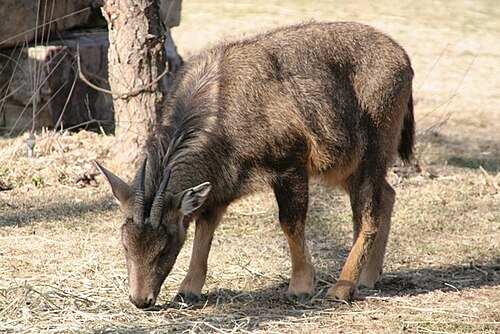
Central Chinese or long-tailed goral ( Naemorhedus caudatus ) in the St. Louis Zoo , Missouri, United States.
Photo: Robert Lawton at English Wikipedia · CC BY-SA 3.0 · Wikimedia Commons Source
Long-tailed Goral
Naemorhedus caudatus (Long-tailed Goral · オナガゴーラル)
💡 Everyday Comparisons for Size, Mass & Speed
- 📏 Length 1.05m — ~3.5× the long side of an A4 sheet (29.7 cm)
- ⚖️ Mass 25kg — Equivalent to ~12.5 two-liter water bottles (2 kg each)
- ⚡ Speed 45km/h — ~1.2× Usain Bolt's 100 m world-record average speed (37.6 km/h)
Reference standards: coach bus ~12 m, mid-size car ~4.9 m, compact car ~1 t, basketball hoop 3.05 m, credit card 8.56 cm.
Site-computed relative index from recorded values; not a formal scientific metric.
📖 1. Overview
Retaining primitive traits from the Ice Age 2 million years ago, this guardian of alpine rock cliffs on the Korean Peninsula is called a 'living fossil' (Natural Monument (Korea) No. 217).
🌐 Wikipedia Summary ExtractThe long-tailed goral or Amur goral is a species of ungulate of the family Bovidae found in the mountains of eastern and northern Asia, including Russia, China, and Korea. A population of this species exists in the Korean Demilitarized Zone, near the tracks of the Donghae Bukbu Line. The species is classified as endangered in South Korea, with an estimated population less than 250. It has been designated South Korean natural monument 217.
🦴 2. Anatomy & Morphology
With elastic hoof pads, it freely climbs up and down dizzying rock cliffs steeper than 70 degrees.
🔍 3. Ecology & Behavior
It has a unique territory-marking habit of defecating only in fixed spots around its rocky shelters.
🇰🇷 4. Connection to Korea
It is a key indicator species of the Demilitarized Zone (DMZ), Seoraksan, and the Uljin–Samcheok Baekdudaegan ecological axis.
📚 Sources & References
- • Wikipedia “Long-tailed goral”
- • Wikidata Q842374
- • IUCN Red List category VU — latest assessment at iucnredlist.org
- • nie.re.kr — view.do
- • animaldiversity.org — Naemorhedus caudatus
- • Silhouette: PhyloPic — Ferran Sayol · CC0 1.0 (Related taxon silhouette — Rupicapra pyrenaica)
Recorded dimensions are widely cited representative estimates from public literature and may vary by study or specimen.