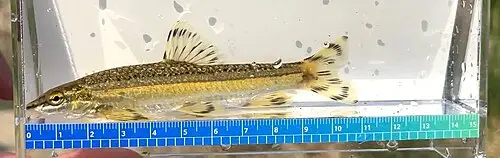
 📸 Photo
Photo: 애니몰로TV · CC BY 3.0 · Wikimedia Commons Source
Korean splendid dace
Coreoleuciscus splendidus (Korean splendid dace · ヤガタムギツク)
Not Evaluated (NE) on the IUCN Red List yet.
💡 Everyday Comparisons for Size, Mass & Speed
- 💡 Its maximum total length of 15 cm is similar to a new ballpoint pen (about 14–15 cm) (Comparison).
- 💡 Because it is an endemic species found nowhere else outside Korea (FishBase), it can be encountered in clear river riffles flowing into the West and South seas (National List of Species of Korea).
Reference standards: coach bus ~12 m, mid-size car ~4.9 m, compact car ~1 t, basketball hoop 3.05 m, credit card 8.56 cm.
📖 1. Overview
The Korean splendid dace is an endemic freshwater fish found only in Korea, living in riffles of the clear middle and upper reaches of rivers. It has a slender, elongated body and a pointed head.
🦴 2. Anatomy & Morphology
Its body is slender and long, and both its head and trunk are flattened from side to side. Its back is black, the top of its head is brown, its belly is bluish white, and its tail fin is relatively deeply forked.
🔍 3. Ecology & Behavior
It lives on gravel bottoms in riffles and mainly feeds on aquatic insects and small animals. Its spawning season is in April and May, when it lays eggs beneath gravel or large stones in riffles.
🇰🇷 4. Connection to Korea
It is a Korean endemic listed on the National List of Species of Korea and distributed across almost all of South Korea except rivers flowing into the East Sea. It is recorded in rivers flowing into the West and South seas, as well as Osipcheon in Samcheok, Wangpicheon in Uljin, and streams on Geojedo.
📚 Sources & References
- • IUCN Red List: not evaluated (NE) — cross-checked with the Wikidata conservation-status entry
- • catalogueoflife.org — YDKV
- • 국가생물종목록(국립생물자원관) ktsn 120000057552 — https://species.nibr.go.kr/home/mainHome.do?cont_link=009&subMenu=009002&contCd=009002&ktsn=120000057552
- • wikidata.org — Q1061980
- • commons.wikimedia.org — File:Coreoleuciscus splendidus (swiri), animalloTV, 1.jpg
- • fishbase.se — Coreoleuciscus-splendidus.html
- • species.nibr.go.kr — mainHome.do
- • Silhouette: PhyloPic — Douglas Teles da Rosa · CC0 1.0 (Related taxon silhouette — Tanichthys albonubes)
Recorded dimensions are widely cited representative estimates from public literature and may vary by study or specimen.