 🎨 Restoration
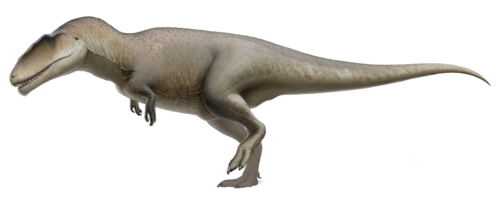
Life restoration of C. saharicus
Restoration: Fred Wierum · CC BY-SA 4.0 · Wikimedia Commons Source
Life restorations are artistic reconstructions based on fossil evidence; true coloration and soft-tissue details remain uncertain.
Carcharodontosaurus
Carcharodontosaurus saharicus (Carcharodontosaurus · カルカロドントサウルス)
Known only from fossils. The IUCN Red List assesses only species extant since 1500 CE, so fossil taxa are not assigned a category.
💡 Everyday Comparisons for Size, Mass & Speed
- 📏 Length 12.5m — ~1× the length of a 12 m coach bus
- 🏢 Height 3.9m — ~2.2× the height of a 1.75 m human
- ⚖️ Mass 6.5t — Equivalent to ~6.5 compact cars (~1 t each)
- ⚡ Speed 30km/h — ~0.8× Usain Bolt's 100 m world-record average speed (37.6 km/h)
Reference standards: coach bus ~12 m, mid-size car ~4.9 m, compact car ~1 t, basketball hoop 3.05 m, credit card 8.56 cm.
Site-computed relative index from recorded values; not a formal scientific metric.
📖 1. Overview
It was a giant North African theropod that hunted massive sauropods using flat, serrated teeth resembling those of a great white shark.
🌐 Wikipedia Summary ExtractCarcharodontosaurus is a genus of large theropod dinosaur that lived in Northwest Africa from about 100 to 94 million years ago during the Cenomanian age of the late Cretaceous period. The genus was first described in 1925 by French paleontologists Charles Depéret and Justin Savornin as Megalosaurus saharicus, based on two fossil teeth discovered in Algeria, which are now lost. A partial skeleton was discovered in Egypt as early as 1914 by crews of German paleontologist Ernst Stromer, although he did not report the find until 1931. Based on this specimen as well as the teeth previously described by Depéret and Savornin, Stromer established the genus Carcharodontosaurus, with C. saharicus as the only species. Although the Egyptian skeleton was destroyed during World War II, it was redescribed as a closely related but distinct genus, Tameryraptor, based on historical photographs in 2025. In 1995, a large incomplete skull attributed to C. saharicus was discovered in the Kem Kem Beds of Morocco, which was officially proposed as the neotype in 2007. In the same year, fossils unearthed from the Farak Formation of Niger were described and named as another species, C. iguidensis, though this taxon might belong to a different genus.
🦴 2. Anatomy & Morphology
With a skull reaching 1.6 m in length, it sliced flesh from large prey using its razor-like teeth.
🔍 3. Fossil Record & Paleoecology
In North Africa during the same period, it shared apex ecological niches by dividing prey with Spinosaurus, which hunted aquatic fish.
🇰🇷 4. Connection to Korea
It is a reference species for studying the evolution of mid-Cretaceous Asian and African theropods.
📚 Sources & References
- • Wikipedia “Carcharodontosaurus”
- • Wikidata Q2313178
- • Fossil taxon — the IUCN Red List assesses only species living or extinct since 1500
- • nhm.ac.uk — carcharodontosaurus.html
- • Silhouette: PhyloPic — Martin Kevil · CC BY 3.0
Recorded dimensions are widely cited representative estimates from public literature and may vary by study or specimen.