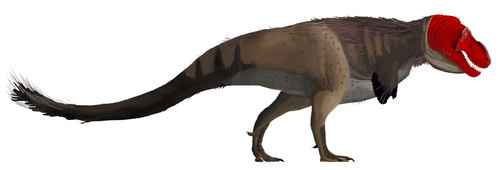
 🎨 Restoration
Restoration showing partial feathering
Restoration: Matt Martyniuk · CC BY-SA 3.0 · Wikimedia Commons Source
Life restorations are artistic reconstructions based on fossil evidence; true coloration and soft-tissue details remain uncertain.
Tyrannosaurus rex
Tyrannosaurus rex (Tyrannosaurus rex · ティラノサウルス・レックス)
Known only from fossils. The IUCN Red List assesses only species extant since 1500 CE, so fossil taxa are not assigned a category.
💡 Everyday Comparisons for Size, Mass & Speed
- 📏 Length 12m — ~1× the length of a 12 m coach bus
- 🏢 Height 4m — ~2.3× the height of a 1.75 m human
- ⚖️ Mass 7t — Equivalent to ~7 compact cars (~1 t each)
- ⚡ Speed 27km/h — ~0.7× Usain Bolt's 100 m world-record average speed (37.6 km/h)
Reference standards: coach bus ~12 m, mid-size car ~4.9 m, compact car ~1 t, basketball hoop 3.05 m, credit card 8.56 cm.
Site-computed relative index from recorded values; not a formal scientific metric.
📖 1. Overview
Boasting the most powerful bite force in the history of terrestrial ecosystems (about 35,000–57,000 N), it was the final and mightiest theropod predator of the Cretaceous.
🌐 Wikipedia Summary ExtractTyrannosaurus is a genus of large theropod dinosaur. The type species Tyrannosaurus rex, often shortened to T. rex or colloquially T-Rex, is one of the best represented theropods. It lived throughout what is now western North America, on what was then an island continent known as Laramidia. Tyrannosaurus had a much wider range than other tyrannosaurids. Fossils are found in geological formations which have been dated to the late Maastrichtian age of the late Cretaceous period, 69 to 66 million years ago, with isolated specimens possibly indicating an earlier origin in the middle Campanian age. It was one of the last known members of the tyrannosaurids and among the last non-avian dinosaurs to exist before the Cretaceous–Paleogene extinction event.
🦴 2. Anatomy & Morphology
With thick, banana-shaped conical teeth (30 cm including the root), it crushed the very bones of its prey (osteophagy), and it possessed forward-facing stereoscopic vision and enormous olfactory bulbs.
🔍 3. Fossil Record & Paleoecology
Through the skeletal specimens 'Sue' and 'Scotty,' adults have been proven to reach 12.3–12.8 m in body length and over 8.8 tonnes in weight.
🇰🇷 4. Connection to Korea
Footprint fossils of large Tarbosaurus-grade theropods—an Asian close relative—have been reported from Cretaceous strata on the Korean Peninsula.
📚 Sources & References
- • Wikipedia “Tyrannosaurus”
- • Wikidata Q13098211
- • Fossil taxon — the IUCN Red List assesses only species living or extinct since 1500
- • nhm.ac.uk — tyrannosaurus.html
- • Silhouette: PhyloPic — Matt Dempsey · CC BY 4.0
Recorded dimensions are widely cited representative estimates from public literature and may vary by study or specimen.