 📸 Photo
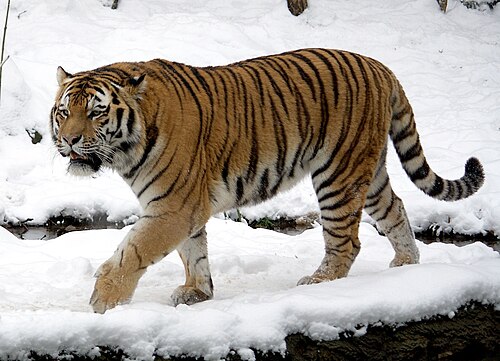
Male Panthera tigris altaica, Leipzig Zoo / Tomak (*27. Mai 2004 in Leipzig, †2. August 2023)
Photo: Appaloosa · CC BY-SA 3.0 · Wikimedia Commons Source
Siberian Tiger (Amur Tiger)
Panthera tigris (Siberian Tiger (Amur Tiger) · アムールトラ (シベリアトラ))
💡 Everyday Comparisons for Size, Mass & Speed
- 📏 Length 3m — ~1.7× the height of a 1.75 m adult human
- ⚖️ Mass 280kg — ~4× the mass of a 70 kg adult human
- ⚡ Speed 60km/h — ~1.6× Usain Bolt's 100 m world-record average speed (37.6 km/h)
Reference standards: coach bus ~12 m, mid-size car ~4.9 m, compact car ~1 t, basketball hoop 3.05 m, credit card 8.56 cm.
Site-computed relative index from recorded values; not a formal scientific metric.
📖 1. Overview
The largest apex predator among extant felids, it is the Korean tiger revered since ancient times as the 'Mountain Lord' (Sangun) of the Korean Peninsula.
🌐 Wikipedia Summary ExtractThe Siberian tiger or Amur tiger is a population of the tiger subspecies Panthera tigris tigris native to Northeast China, the Russian Far East, and possibly North Korea. It once ranged throughout the Korean Peninsula, but was eradicated in the area during the period of Japanese rule between 1910 and 1945, and currently inhabits mainly the Sikhote-Alin mountain region in the southwest of Primorsky Krai in the Russian Far East. In 2005, there were 331–393 adult and subadult Siberian tigers in this region, with a breeding adult population of about 250 individuals. The population had been stable for more than a decade because of intensive conservation efforts, but partial surveys conducted after 2005 indicate that the Russian tiger population was declining. An initial census held in 2015 indicated that the Siberian tiger population had increased to 480–540 individuals in the Russian Far East, including 100 cubs. This was followed up by a more detailed census, which revealed there was a total population of 562 wild Siberian tigers in Russia. As of 2014, about 35 individuals were estimated to be in the international border area between Russia and China. As of 2022, about 756 Siberian tigers, including 200 cubs, were estimated to inhabit the Russian Far East.
🦴 2. Anatomy & Morphology
It has dense winter fur that endures snowfields of -40°C, massive paw pads, a bite force of about 4,500 N, and 10 cm hooked claws.
🔍 3. Ecology & Behavior
It lives a solitary life, with a single male's home range reaching up to 1,000 km². It mainly hunts wild boars and red deer.
🇰🇷 4. Connection to Korea
Designated as Class I endangered wildlife (Korea) by the Ministry of Environment, conservation research is underway at the 'Tiger Forest' of the Baekdudaegan National Arboretum in Bonghwa, Gyeongsangbuk-do.
📚 Sources & References
- • Wikipedia “Siberian tiger”
- • Wikidata Q19939
- • IUCN Red List category EN — latest assessment at iucnredlist.org
- • nationalzoo.si.edu — tiger
- • Silhouette: PhyloPic — Sarah Werning · CC BY 3.0
Recorded dimensions are widely cited representative estimates from public literature and may vary by study or specimen.