 🎨 Restoration
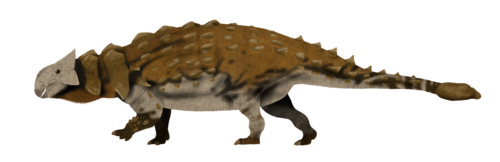
Life restoration
Restoration: Sphenaphinae · CC BY-SA 4.0 · Wikimedia Commons Source
Life restorations are artistic reconstructions based on fossil evidence; true coloration and soft-tissue details remain uncertain.
Ankylosaurus
Ankylosaurus magniventris (Ankylosaurus · アンキロサウルス)
Known only from fossils. The IUCN Red List assesses only species extant since 1500 CE, so fossil taxa are not assigned a category.
💡 Everyday Comparisons for Size, Mass & Speed
- 📏 Length 8m — ~1.6× the length of a mid-size sedan (4.9 m)
- 🏢 Height 1.7m — ~1× the height of a 1.75 m human
- ⚖️ Mass 6t — Equivalent to ~6 compact cars (~1 t each)
- ⚡ Speed 12km/h — ~3× human walking speed (~4 km/h)
Reference standards: coach bus ~12 m, mid-size car ~4.9 m, compact car ~1 t, basketball hoop 3.05 m, credit card 8.56 cm.
Site-computed relative index from recorded values; not a formal scientific metric.
📖 1. Overview
Covered in tough bony armor even over its eyelids and equipped with a 60 kg bony club at the tip of its tail, it was a 'living tank of the Cretaceous.'
🌐 Wikipedia Summary ExtractAnkylosaurus is a genus of armored dinosaur. Its fossils have been found in geological formations dating to the very end of the Cretaceous Period, about 70-66 million years ago, in western North America, making it among the last of the non-avian dinosaurs. It was named by Barnum Brown in 1908; it is monotypic, containing only A. magniventris. The generic name means "fused" or "bent lizard", and the specific name means "great belly". A handful of specimens have been excavated to date, but a complete skeleton has not been discovered. Though other members of Ankylosauria are represented by more extensive fossil material, Ankylosaurus is often considered the archetypal member of its group, despite having some unusual features.
🦴 2. Anatomy & Morphology
A strike from its tail club could fracture the ankle bones of a large theropod in a single blow.
🔍 3. Fossil Record & Paleoecology
Through its intricately looped nasal passages, it cooled inhaled air and produced low-frequency vocalizations.
🇰🇷 4. Connection to Korea
Ankylosaurian footprint fossils have also been found in Cretaceous strata on the Korean Peninsula, including in Goseong, Gyeongnam.
📚 Sources & References
- • Wikipedia “Ankylosaurus”
- • Wikidata Q22103730
- • Fossil taxon — the IUCN Red List assesses only species living or extinct since 1500
- • nhm.ac.uk — ankylosaurus.html
- • Silhouette: PhyloPic — author not recorded · CC0 1.0
Recorded dimensions are widely cited representative estimates from public literature and may vary by study or specimen.