 📸 Photo
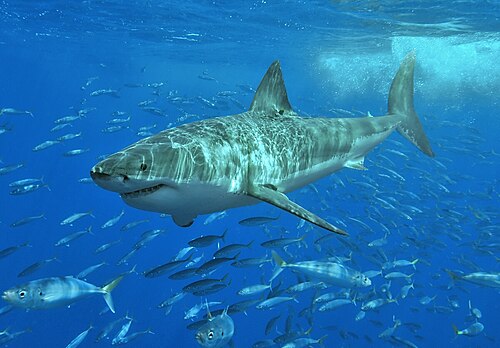
Great white shark at Isla Guadalupe, Mexico, August 2006. Shot with Nikon D70s in Ikelite housing, in natural light. Animal estimated at 11-12 feet (3.3 to 3.6 m) in length, age unknown.
Photo: Pterantula (Terry Goss) at en.wikipedia · CC BY 2.5 · Wikimedia Commons Source
Great White Shark
Carcharodon carcharias (Great White Shark · ホオジロザメ)
💡 Everyday Comparisons for Size, Mass & Speed
- 📏 Length 6.1m — ~1.2× the length of a mid-size sedan (4.9 m)
- 🏢 Height 1.5m — ~0.9× the height of a 1.75 m human
- ⚖️ Mass 2.2t — Equivalent to ~2.2 compact cars (~1 t each)
- ⚡ Speed 56km/h — ~1.5× Usain Bolt's 100 m world-record average speed (37.6 km/h)
Reference standards: coach bus ~12 m, mid-size car ~4.9 m, compact car ~1 t, basketball hoop 3.05 m, credit card 8.56 cm.
Site-computed relative index from recorded values; not a formal scientific metric.
📖 1. Overview
Exceeding 6 m in body length and 2 tonnes in weight, it is the largest living predatory fish. It exhibits endothermy, maintaining its muscle temperature higher than the surrounding seawater.
🌐 Wikipedia Summary ExtractThe great white shark, also known as the white shark, white pointer, or great white, is a large shark. It is closely related to the mako sharks, the porbeagle, and the salmon shark. It is a robustly built species with a grayish upperside and a white underside. The white shark is one of the largest living shark and fish species, though it is still smaller than the whale shark and basking shark. It has about 300 triangular, serrated teeth that are continuously replaced. Its massive, fatty liver can reach over a quarter of its body weight, providing buoyancy and storing energy. The species is partially warm-blooded, an adaptation that allows it to remain active in colder waters.
🦴 2. Anatomy & Morphology
Using the ampullae of Lorenzini on the tip of its snout, it detects the faint magnetic fields of a creature's heartbeat, and its 300 serrated teeth are replaced by tens of thousands of new ones over its lifetime.
🔍 3. Ecology & Behavior
When hunting seals, it employs a breaching technique, charging vertically from the depths so that its entire body launches above the water surface.
🇰🇷 4. Connection to Korea
As it also appears along the coasts of the West, South, and East Seas of Korea during periods of rising water temperatures, it has become a subject of marine safety research.
📚 Sources & References
- • Wikipedia “Great white shark”
- • Wikidata Q129026
- • IUCN Red List category VU — latest assessment at iucnredlist.org
- • fishbase.se — Carcharodon-carcharias.html
- • animaldiversity.org — Carcharodon carcharias
- • Silhouette: PhyloPic — Steven Traver · CC0 1.0
Recorded dimensions are widely cited representative estimates from public literature and may vary by study or specimen.