 🦴 Fossil
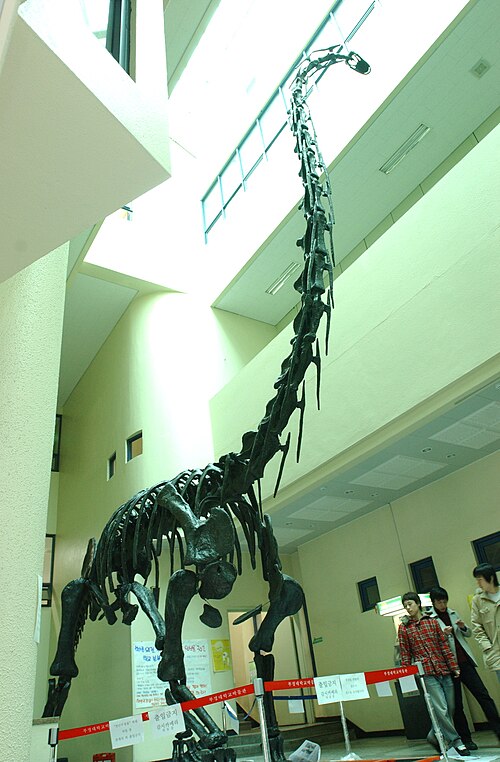
Pukyongosaurus Skeleton
Photo: 박동찬 · CC BY-SA 3.0 · Wikimedia Commons Source
Pukyongosaurus millenniumi
Pukyongosaurus millenniumi (Pukyongosaurus millenniumi · プギョンゴサウルス)
Known only from fossils. The IUCN Red List assesses only species extant since 1500 CE, so fossil taxa are not assigned a category.
💡 Everyday Comparisons for Size, Mass & Speed
- 📏 Length 15m — ~1.3× the length of a 12 m coach bus
- 🏢 Height 6.5m — ~2.3 building stories tall (~2.8 m per floor)
Reference standards: coach bus ~12 m, mid-size car ~4.9 m, compact car ~1 t, basketball hoop 3.05 m, credit card 8.56 cm.
📖 1. Overview
Excavated with articulated neck and back vertebrae on Dolseom Island in Hadong-gun, Gyeongsangnam-do, it is a representative giant sauropod dinosaur of the Korean Peninsula.
🌐 Wikipedia Summary ExtractPukyongosaurus is a genus of titanosauriform dinosaur that lived in South Korea during the Early Cretaceous Period. It may have been closely related to Euhelopus, and is known from a series of vertebrae in the neck and back. The characteristics that were originally used to distinguish this genus have been criticized as being either widespread or too poorly preserved to evaluate, rendering the genus an indeterminate nomen dubium among titanosauriforms. A 2022 study noted that Pukyongosaurus is probably a somphospondylan.
🦴 2. Anatomy & Morphology
With its long neck and spoon-shaped teeth, it fed on conifer leaves around lakes on the Korean Peninsula during the Early Cretaceous.
🔍 3. Fossil Record & Paleoecology
Studied and described in the millennium year 2000, it was given the specific epithet "millenniumi."
🇰🇷 4. Connection to Korea
It is the top candidate for the trackmaker of the numerous giant sauropod footprint fossils found across Goseong, Hadong, and Sacheon.
📚 Sources & References
- • Wikipedia “Pukyongosaurus”
- • Wikidata Q57273328
- • Fossil taxon — the IUCN Red List assesses only species living or extinct since 1500
- • Silhouette: PhyloPic — Cy Marchant · CC BY 4.0 (Related taxon silhouette — Chucarosaurus diripienda)
Recorded dimensions are widely cited representative estimates from public literature and may vary by study or specimen.