 📸 Photo
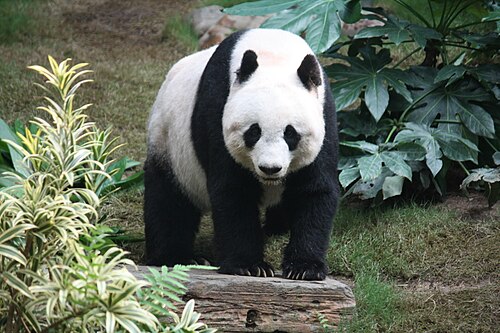
Giant Panda at Ocean Park Hong Kong
Photo: J. Patrick Fischer · CC BY-SA 3.0 · Wikimedia Commons Source
Giant Panda
Ailuropoda melanoleuca (Giant Panda · ジャイアントパンダ)
💡 Everyday Comparisons for Size, Mass & Speed
- 📏 Length 1.5m — ~0.9× the height of a 1.75 m adult human
- ⚖️ Mass 80kg — ~1.1× the mass of a 70 kg adult human
- ⚡ Speed 32km/h — ~0.9× Usain Bolt's 100 m world-record average speed (37.6 km/h)
Reference standards: coach bus ~12 m, mid-size car ~4.9 m, compact car ~1 t, basketball hoop 3.05 m, credit card 8.56 cm.
Site-computed relative index from recorded values; not a formal scientific metric.
📖 1. Overview
Although belonging to the family Ursidae in the order Carnivora, it evolved a unique herbivorous adaptation with bamboo making up 99% of its diet, serving as the symbol of the World Wide Fund for Nature (WWF).
🌐 Wikipedia Summary ExtractThe giant panda, also known as the panda bear or simply panda, is a bear species endemic to China. It is characterised by its white coat with black patches around the eyes, ears, legs and shoulders. Its body is rotund; adult individuals weigh 100 to 115 kg and are typically 1.2 to 1.9 m long. It is sexually dimorphic, with males being typically 10–20% larger than females. A thumb is visible on its forepaw, which helps in holding bamboo in place for feeding. It has large molar teeth and expanded temporal fossae to meet its dietary requirements. It can digest starch and is mostly herbivorous with a diet consisting almost entirely of bamboo and bamboo shoots.
🦴 2. Anatomy & Morphology
A protruding wrist bone (radial sesamoid) functions like a sixth finger (pseudo-thumb), allowing it to grasp slippery bamboo stalks precisely and strip their bark.
🔍 3. Ecology & Behavior
Because its digestive tract still retains the short intestine structure of carnivorans and absorbs only about 17% of bamboo nutrients, it must spend 14 hours a day eating up to 38 kg of bamboo.
🇰🇷 4. Connection to Korea
It is a species that has received nationwide love in Korea through 'Fu Bao,' the first giant panda born in Korea, and her twin younger sisters.
📚 Sources & References
- • Wikipedia “Giant panda”
- • Wikidata Q33602
- • IUCN Red List category VU — latest assessment at iucnredlist.org
- • animaldiversity.org — Ailuropoda melanoleuca
- • Silhouette: PhyloPic — Margot Michaud · CC0 1.0
Recorded dimensions are widely cited representative estimates from public literature and may vary by study or specimen.