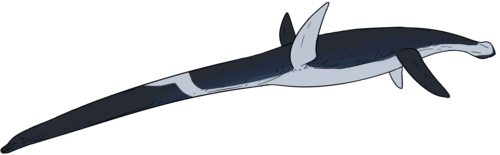
 🎨 Restoration
Life restoration
Restoration: Connor Ashbridge · CC BY-SA 4.0 · Wikimedia Commons Source
Life restorations are artistic reconstructions based on fossil evidence; true coloration and soft-tissue details remain uncertain.
Elasmosaurus
Elasmosaurus platyurus (Elasmosaurus · エラスモサウルス)
Known only from fossils. The IUCN Red List assesses only species extant since 1500 CE, so fossil taxa are not assigned a category.
💡 Everyday Comparisons for Size, Mass & Speed
- 📏 Length 10.3m — ~0.9× the length of a 12 m coach bus
- 🏢 Height 1.8m — ~1× the height of a 1.75 m human
- ⚖️ Mass 2.1t — Equivalent to ~2.1 compact cars (~1 t each)
- ⚡ Speed 28km/h — ~0.7× Usain Bolt's 100 m world-record average speed (37.6 km/h)
Reference standards: coach bus ~12 m, mid-size car ~4.9 m, compact car ~1 t, basketball hoop 3.05 m, credit card 8.56 cm.
Site-computed relative index from recorded values; not a formal scientific metric.
📖 1. Overview
A representative long-necked plesiosaur (elasmosaurid) whose neck alone measured 7.1 m (with 72 cervical vertebrae) out of a total body length of 10.3 m.
🌐 Wikipedia Summary ExtractElasmosaurus is a genus of plesiosaur that lived in North America during the Campanian stage of the Late Cretaceous period, at about 80.6 to 77 million years ago. The first specimen was discovered in 1867 near Fort Wallace, Kansas, US, and was sent to the American paleontologist Edward Drinker Cope, who named it E. platyurus in 1868. The generic name means "thin-plate reptile", and the specific name means "flat-tailed". Cope originally reconstructed the skeleton of Elasmosaurus with the skull at the end of the tail, an error which was made light of by the paleontologist Othniel Charles Marsh, and became part of their "Bone Wars" rivalry. Only one incomplete Elasmosaurus skeleton is definitely known, consisting of a fragmentary skull, the spine, and now lost pectoral and pelvic girdles, and a single species is recognized today; other species are now considered invalid or have been moved to other genera. A fragmentary specimen from Germany may belong to this genus.
🦴 2. Anatomy & Morphology
It swam by flapping its four flipper-like limbs as if flying underwater.
🔍 3. Fossil Record & Paleoecology
It is an iconic specimen of the 19th-century paleontological "Bone Wars."
🇰🇷 4. Connection to Korea
It is a representative species illustrating the aquatic adaptation of Mesozoic marine reptiles.
📚 Sources & References
- • Wikipedia “Elasmosaurus”
- • Wikidata Q20717895
- • Fossil taxon — the IUCN Red List assesses only species living or extinct since 1500
- • Silhouette: PhyloPic — E. D. Cope (modified by T. Michael Keesey, Michael P. Taylor & Matthew J. Wedel) · CC BY 3.0
Recorded dimensions are widely cited representative estimates from public literature and may vary by study or specimen.