 📸 Photo
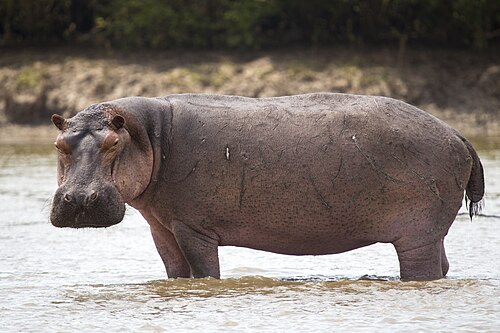
Portrait of a Hippopotamus in water in Saadani National Park
Photo: Muhammad Mahdi Karim · CC BY-SA 4.0 · Wikimedia Commons Source
Hippopotamus
Hippopotamus amphibius (Hippopotamus · カバ)
💡 Everyday Comparisons for Size, Mass & Speed
- 📏 Length 2.09m — ~1.2× the height of a 1.75 m adult human
- 🏢 Height 1.5m — ~0.9× the height of a 1.75 m human
- ⚖️ Mass 1.3t — ~18.6× the mass of a 70 kg adult human
- ⚡ Speed 30km/h — ~0.8× Usain Bolt's 100 m world-record average speed (37.6 km/h)
Reference standards: coach bus ~12 m, mid-size car ~4.9 m, compact car ~1 t, basketball hoop 3.05 m, credit card 8.56 cm.
Site-computed relative index from recorded values; not a formal scientific metric.
📖 1. Overview
In molecular phylogenetics, it is the closest living terrestrial relative of extant cetaceans (Cetacea) and the most feared semi-aquatic megaherbivore along African waterways.
🌐 Wikipedia Summary ExtractThe hippopotamus, often shortened to hippo, further qualified as the common hippopotamus, Nile hippopotamus and river hippopotamus, is a large semiaquatic mammal native to sub-Saharan Africa. It is one of only two extant species in the family Hippopotamidae, the other being the pygmy hippopotamus. Its name comes from the Ancient Greek for "river horse" (ἱπποπόταμος).
🦴 2. Anatomy & Morphology
Capable of opening its mouth up to 150 degrees and armed with 50 cm canines and a bite force of about 8,100 N, it can overpower crocodiles or lions in an instant.
🔍 3. Ecology & Behavior
Its skin secretes a reddish 'hipposudoric acid' mucus that simultaneously blocks UV rays and prevents bacterial infection.
🇰🇷 4. Connection to Korea
It is a core organism for teaching the evolutionary phylogenetics of Whippomorpha (artiodactyls and cetaceans).
📚 Sources & References
- • Wikipedia “Hippopotamus”
- • Wikidata Q34505
- • IUCN Red List category VU — latest assessment at iucnredlist.org
- • animaldiversity.org — Hippopotamus amphibius
- • Silhouette: PhyloPic — Jan A. Venter, Herbert H. T. Prins, David A. Balfour & Rob Slotow (vectorized by T. Michael Keesey) · CC BY 3.0
Recorded dimensions are widely cited representative estimates from public literature and may vary by study or specimen.