 📸 Photo
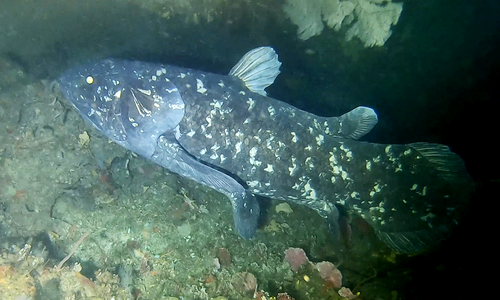
Coelacanth 69 m off Pumula on the KwaZulu-Natal South Coast , South Africa, on 22 November 2019 (photo: Bruce Henderson)
Photo: Bruce A.S. Henderson · CC BY 4.0 · Wikimedia Commons Source
West Indian Ocean Coelacanth
Latimeria chalumnae (West Indian Ocean Coelacanth · シーラカンス)
💡 Everyday Comparisons for Size, Mass & Speed
- 📏 Length 1.9m — ~1.1× the height of a 1.75 m adult human
- ⚖️ Mass 90kg — ~1.3× the mass of a 70 kg adult human
- ⚡ Speed 8km/h — ~2× human walking speed (~4 km/h)
Reference standards: coach bus ~12 m, mid-size car ~4.9 m, compact car ~1 t, basketball hoop 3.05 m, credit card 8.56 cm.
Site-computed relative index from recorded values; not a formal scientific metric.
📖 1. Overview
Once thought to have gone completely extinct 66 million years ago along with the dinosaurs at the end of the Cretaceous, it stunned the global scientific community when a living specimen was discovered off South Africa in 1938, making it the quintessential 'living fossil.'
🌐 Wikipedia Summary ExtractCoelacanths are an ancient group of lobe-finned fish (Sarcopterygii) in the class Actinistia. As sarcopterygians, they are more closely related to lungfish and tetrapods than to ray-finned fish. There is only a single living genus, Latimeria, with two described species.
🦴 2. Anatomy & Morphology
Unlike ordinary ray-finned fishes, it is a lobe-finned fish (Sarcopterygii) with bones and muscles inside its fins, showing how tetrapod limbs evolved from fish fins.
🔍 3. Ecology & Behavior
It is an ultra-slow-metabolism deep-sea organism with a lifespan of up to 100 years and a gestation period of 5 years—the longest of any vertebrate.
🇰🇷 4. Connection to Korea
It is the primary specimen for teaching the evolutionary transition from fishes to amphibians onto land.
📚 Sources & References
- • Wikipedia “Coelacanth”
- • Wikidata Q668921
- • IUCN Red List category CR — latest assessment at iucnredlist.org
- • fishbase.se — Latimeria-chalumnae.html
- • Silhouette: PhyloPic — Yan Wong · Public Domain Mark 1.0
Recorded dimensions are widely cited representative estimates from public literature and may vary by study or specimen.