 🎨 Restoration
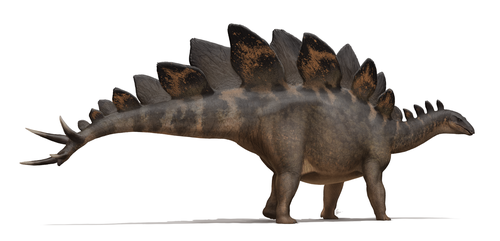
Life restoration of Sophie, depicting the modern view of S. stenops
Restoration: Fred Wierum · CC BY-SA 4.0 · Wikimedia Commons Source
Life restorations are artistic reconstructions based on fossil evidence; true coloration and soft-tissue details remain uncertain.
Stegosaurus
Stegosaurus stenops (Stegosaurus · ステゴサウルス)
Known only from fossils. The IUCN Red List assesses only species extant since 1500 CE, so fossil taxa are not assigned a category.
💡 Everyday Comparisons for Size, Mass & Speed
- 📏 Length 9m — ~1.8× the length of a mid-size sedan (4.9 m)
- 🏢 Height 4m — ~2.3× the height of a 1.75 m human
- ⚖️ Mass 5.3t — Equivalent to ~5.3 compact cars (~1 t each)
- ⚡ Speed 16km/h — ~4× human walking speed (~4 km/h)
Reference standards: coach bus ~12 m, mid-size car ~4.9 m, compact car ~1 t, basketball hoop 3.05 m, credit card 8.56 cm.
Site-computed relative index from recorded values; not a formal scientific metric.
📖 1. Overview
It is a Jurassic stegosaur famous for the 17 diamond-shaped bony plates along its back and the 4 tail spikes (thagomizer) at the tip of its tail.
🌐 Wikipedia Summary ExtractStegosaurus is a genus of extinct herbivorous four-legged armored dinosaurs from the Late Jurassic, characterized by the distinctive kite-shaped upright plates along their backs and spikes on their tails. Fossils of the genus have been found in the western United States and in Portugal, where they are found in Kimmeridgian- to Tithonian-aged strata, dating to between 155 and 145 million years ago. Of the species that have been classified in the upper Morrison Formation of the western US, only three are universally recognized: S. stenops, S. ungulatus and S. sulcatus. The remains of over 80 individual animals of this genus have been found. Stegosaurus would have lived alongside dinosaurs such as Apatosaurus, Diplodocus, Camarasaurus and Allosaurus, the latter of which may have preyed on it.
🦴 2. Anatomy & Morphology
It regulated its body temperature through the vascular network in its dorsal plates and swung its tail spikes to fend off Allosaurus.
🔍 3. Fossil Record & Paleoecology
It is a representative herbivorous dinosaur of the Late Jurassic Morrison Formation.
🇰🇷 4. Connection to Korea
It is a key specimen for explaining the evolution of Mesozoic ornithischian armored dinosaurs.
📚 Sources & References
- • Wikipedia “Stegosaurus”
- • Wikidata Q20719356
- • Fossil taxon — the IUCN Red List assesses only species living or extinct since 1500
- • nhm.ac.uk — stegosaurus.html
- • Silhouette: PhyloPic — author not recorded · CC0 1.0
Recorded dimensions are widely cited representative estimates from public literature and may vary by study or specimen.