 📸 Photo
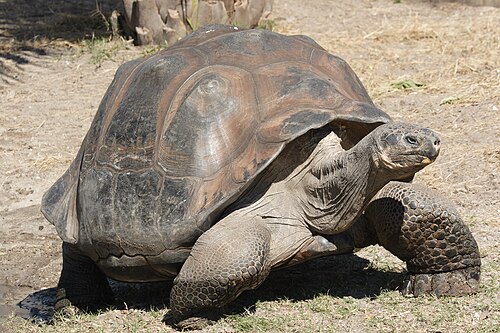
A dome-shelled Galápagos giant tortoise, Chelonoidis nigra
Photo: Mfield , Matthew Field, http://www.photography.mattfield.com · CC BY-SA 3.0 · Wikimedia Commons Source
Galápagos Giant Tortoise
Chelonoidis niger (Galápagos Giant Tortoise · ガラパゴスゾウガメ)
On the IUCN Red List, Chelonoidis niger (in the strict sense, the Floreana giant tortoise) is listed as Extinct (EX). The living Galápagos giant tortoises on different islands are evaluated separately as distinct species — for example, C. porteri in western Santa Cruz Island as Critically Endangered (CR) and C. becki at Wolf Volcano on Isabela Island as Vulnerable (VU). Because this page covers tortoises across multiple islands together, a single status is not assigned.
💡 Everyday Comparisons for Size, Mass & Speed
- 📏 Length 1.2m — ~0.7× the height of a 1.75 m adult human
- ⚖️ Mass 320kg — ~4.6× the mass of a 70 kg adult human
- ⚡ Speed 0.3km/h — ~0.1× human walking speed (~4 km/h)
Reference standards: coach bus ~12 m, mid-size car ~4.9 m, compact car ~1 t, basketball hoop 3.05 m, credit card 8.56 cm.
Site-computed relative index from recorded values; not a formal scientific metric.
📖 1. Overview
The largest extant group of tortoises, with large individuals reaching 300–400 kg and living over 100 years. The fact that shell shapes differ across the Galápagos islands is famous as one of the observations that inspired Darwin's theory of natural selection. The IUCN Red List assesses the tortoises of different islands as separate species (e.g., western Santa Cruz Island C. porteri as Critically Endangered CR, Volcán Wolf on Isabela Island C. becki as Vulnerable VU), while the scientific name Chelonoidis niger in the strict sense refers to the already Extinct (EX) Floreana Island tortoise. Because this page covers the Galápagos giant tortoise group as a whole (species complex), a single conservation status is not assigned.
🌐 Wikipedia Summary ExtractThe Galápagos tortoise, also called the Galápagos giant tortoise, is a very large species of tortoise in the genus Chelonoidis. The species comprises 15 subspecies. It is the largest living species of tortoise, and can weigh up to 417 kg (919 lb). They are also the largest extant terrestrial cold-blooded animals (ectotherms).
🦴 2. Anatomy & Morphology
Subspecies on humid islands underwent adaptive radiation to develop rounded 'dome-shaped shells' for grazing on low grass, whereas subspecies on dry islands evolved upturned 'saddle-backed shells' to reach tall cacti.
🔍 3. Ecology & Behavior
With an extremely slow metabolism, it can survive up to 1 year without food or water, and its anti-aging and cancer-resistance genes are actively studied.
🇰🇷 4. Connection to Korea
Alongside the turtle symbol of the Ten Symbols of Longevity (Sipjangsaeng), it serves as a premier specimen for teaching evolutionary theory.
📚 Sources & References
- • IUCN Red List of Threatened Species — taxon 9023 Chelonoidis niger (Floreana giant tortoise, strict sense): Extinct (EX); living island taxa assessed as separate species, e.g. taxon 9026 Chelonoidis porteri: Critically Endangered, taxon 9018 Chelonoidis becki: Vulnerable. Checked in the IUCN Red List checklist dataset on GBIF (https://www.gbif.org/dataset/19491596-35ae-4a91-9a98-85cf505f1bd3), 2026-10-25
- • Wikipedia “Galápagos tortoise”
- • Wikidata Q486672
- • IUCN Red List — no single category for this grouping; its member species are assessed separately
- • ielc.libguides.com — galapagostortoises
- • Silhouette: PhyloPic — Kai Caspar · CC0 1.0 (Congeneric silhouette — Chelonoidis carbonarius)
Recorded dimensions are widely cited representative estimates from public literature and may vary by study or specimen.