 🎨 Restoration
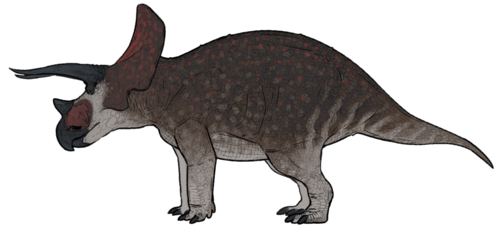
Triceratops horridus life reconstruction based on P 256878
Restoration: Connor Ashbridge · CC BY-SA 4.0 · Wikimedia Commons Source
Life restorations are artistic reconstructions based on fossil evidence; true coloration and soft-tissue details remain uncertain.
Triceratops
Triceratops horridus (Triceratops · トリケラトプス)
Known only from fossils. The IUCN Red List assesses only species extant since 1500 CE, so fossil taxa are not assigned a category.
💡 Everyday Comparisons for Size, Mass & Speed
- 📏 Length 9m — ~1.8× the length of a mid-size sedan (4.9 m)
- 🏢 Height 3m — ~1.7× the height of a 1.75 m human
- ⚖️ Mass 9t — Equivalent to ~9 compact cars (~1 t each)
- ⚡ Speed 26km/h — ~0.7× Usain Bolt's 100 m world-record average speed (37.6 km/h)
Reference standards: coach bus ~12 m, mid-size car ~4.9 m, compact car ~1 t, basketball hoop 3.05 m, credit card 8.56 cm.
Site-computed relative index from recorded values; not a formal scientific metric.
📖 1. Overview
Armed with three horns and a massive 2.5 m-long bony frill, it was a representative Cretaceous ceratopsian that stood against Tyrannosaurus.
🌐 Wikipedia Summary ExtractTriceratops is a genus of chasmosaurine ceratopsian dinosaur that lived during the late Maastrichtian age of the Late Cretaceous period, about 69 to 66 million years ago on the island continent of Laramidia, now forming western North America. It was one of the last-known non-avian dinosaurs and lived until the Cretaceous–Paleogene extinction event 66 million years ago. The name Triceratops, which means 'three-horned face', is derived from Ancient Greek trí-, meaning 'three', kéras, meaning 'horn', and ṓps, meaning 'face'.
🦴 2. Anatomy & Morphology
Thanks to a ball-and-socket neck joint, it could rapidly pivot its massive head and 1 m brow horns in any direction for defense.
🔍 3. Fossil Record & Paleoecology
The excavation of frill fossils with healed Tyrannosaurus bite marks proved that real battles took place between them.
🇰🇷 4. Connection to Korea
Koreaceratops, discovered in Hwaseong, represents an important early Asian relative in the ceratopsian lineage that later gave rise to Triceratops.
📚 Sources & References
- • Wikipedia “Triceratops”
- • Wikidata Q3998678
- • Fossil taxon — the IUCN Red List assesses only species living or extinct since 1500
- • nhm.ac.uk — triceratops.html
- • Silhouette: PhyloPic — Ivan Iofrida · CC BY 4.0
Recorded dimensions are widely cited representative estimates from public literature and may vary by study or specimen.