 📸 Photo
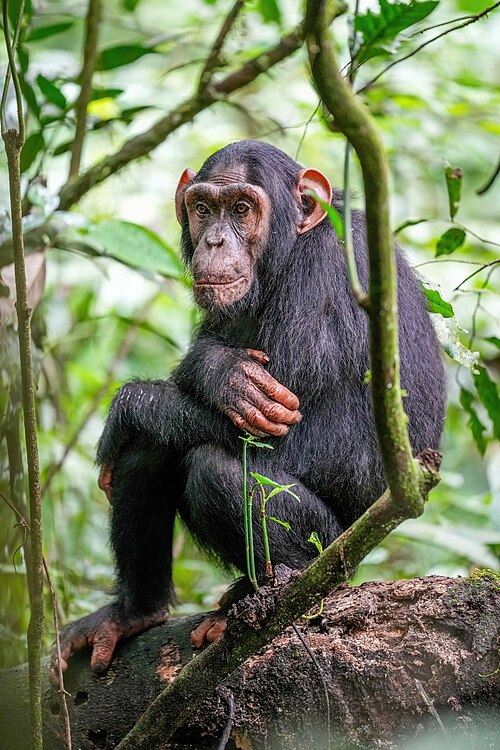
Chimpanzee at Kibale forest National Park
Photo: Giles Laurent · CC BY-SA 4.0 · Wikimedia Commons Source
Chimpanzee
Pan troglodytes (Chimpanzee · チンパンジー)
💡 Everyday Comparisons for Size, Mass & Speed
- 📏 Length 63.5cm — ~2.1× the long side of an A4 sheet (29.7 cm)
- ⚖️ Mass 26kg — Equivalent to ~13 two-liter water bottles (2 kg each)
- ⚡ Speed 40km/h — ~1.1× Usain Bolt's 100 m world-record average speed (37.6 km/h)
Reference standards: coach bus ~12 m, mid-size car ~4.9 m, compact car ~1 t, basketball hoop 3.05 m, credit card 8.56 cm.
Site-computed relative index from recorded values; not a formal scientific metric.
📖 1. Overview
Sharing about 98.8% of its genes with modern humans (Homo sapiens), it is our closest evolutionary sister species.
🌐 Wikipedia Summary ExtractThe chimpanzee, commonly abbreviated to chimp, is a medium-sized great ape species found in the forests and savannas of equatorial Africa. It has four confirmed subspecies and a fifth proposed one. The chimpanzee shares the genus Pan with the bonobo. Evidence from fossils and DNA sequencing shows that the two species are humans' closest living relatives. The chimpanzee is bigger and more robust than the bonobo. It is covered in coarse black hair but has a bare face, fingers, toes, palms of the hands, and soles of the feet.
🦴 2. Anatomy & Morphology
Each regional group passes down its own distinct tool-use culture, such as fishing for termites with twigs and cracking nuts with stone hammers and anvils.
🔍 3. Ecology & Behavior
Dr. Jane Goodall's research in Gombe, Tanzania proved that non-human animals also make tools and possess complex emotions.
🇰🇷 4. Connection to Korea
It is a core reference species for studying human evolutionary history and animal cognitive science.
📚 Sources & References
- • Wikipedia “Chimpanzee”
- • Wikidata Q4126704
- • IUCN Red List category EN — latest assessment at iucnredlist.org
- • animaldiversity.org — Pan troglodytes
- • Silhouette: PhyloPic — Jonathan Lawley · CC0 1.0
Recorded dimensions are widely cited representative estimates from public literature and may vary by study or specimen.