 📸 Photo
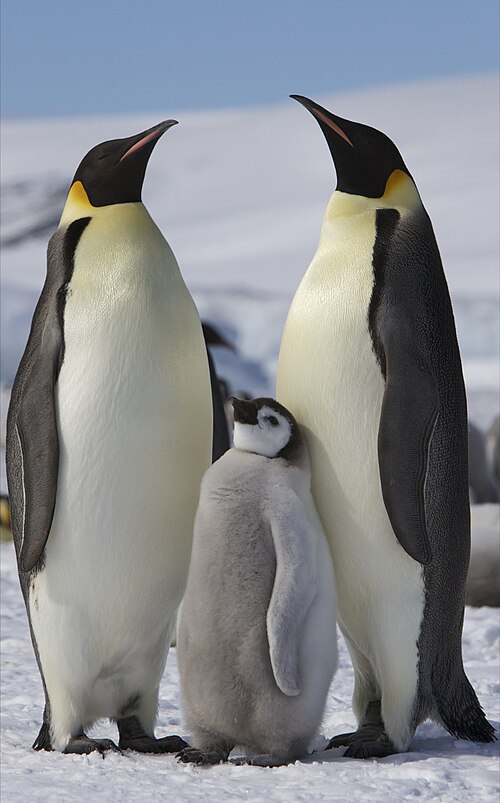
Two adult Emperor Penguins with a juvenile on Snow Hill Island , Antarctica.
Photo: Ian Duffy from UK · CC BY 2.0 · Wikimedia Commons Source
Emperor Penguin
Aptenodytes forsteri (Emperor Penguin · コウテイペンギン)
💡 Everyday Comparisons for Size, Mass & Speed
- 📏 Length 1.2m — ~0.7× the height of a 1.75 m adult human
- 🪽 Wingspan 76cm — Wingspan is ~0.4× the height of a 1.75 m human
- ⚖️ Mass 25kg — Equivalent to ~12.5 two-liter water bottles (2 kg each)
- ⚡ Speed 15km/h — ~3.8× human walking speed (~4 km/h)
Reference standards: coach bus ~12 m, mid-size car ~4.9 m, compact car ~1 t, basketball hoop 3.05 m, credit card 8.56 cm.
Site-computed relative index from recorded values; not a formal scientific metric.
📖 1. Overview
The largest and heaviest of the 18 extant penguin species, an avatar of extreme survival that breeds in the dead of the Antarctic winter at -60°C.
🌐 Wikipedia Summary ExtractThe emperor penguin is the tallest and heaviest of all living penguin species and is endemic to Antarctica. The male and female are similar in plumage and size, reaching 100 cm (39 in) in length and weighing from 22 to 45 kg. Feathers of the head and back are black and sharply delineated from the white belly, pale-yellow breast and bright-yellow ear patches.
🦴 2. Anatomy & Morphology
With high bone density suited for diving and wings evolved into rigid flippers, it dives to depths of 565 m and holds its breath for over 20 minutes.
🔍 3. Ecology & Behavior
'Huddling,' in which thousands of males press closely together to share body warmth while balancing eggs on their feet, is one of nature's greatest cooperative survival strategies.
🇰🇷 4. Connection to Korea
It is a key protected subject of Ross Sea ecological research near South Korea's Antarctic Jang Bogo Station.
📚 Sources & References
- • Wikipedia “Emperor penguin”
- • Wikidata Q161829
- • IUCN Red List category NT — latest assessment at iucnredlist.org
- • animaldiversity.org — Aptenodytes forsteri
- • Silhouette: PhyloPic — author not recorded · CC0 1.0
Recorded dimensions are widely cited representative estimates from public literature and may vary by study or specimen.