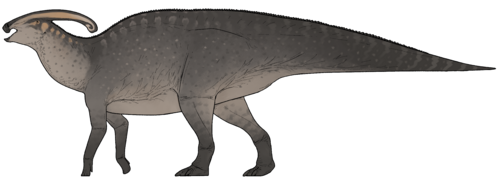
 🎨 Restoration
Restoration of P. walkeri
Restoration: Connor Ashbridge · CC BY-SA 4.0 · Wikimedia Commons Source
Life restorations are artistic reconstructions based on fossil evidence; true coloration and soft-tissue details remain uncertain.
Parasaurolophus
Parasaurolophus walkeri (Parasaurolophus · パラサウロロフス)
Known only from fossils. The IUCN Red List assesses only species extant since 1500 CE, so fossil taxa are not assigned a category.
💡 Everyday Comparisons for Size, Mass & Speed
- 📏 Length 9m — ~1.8× the length of a mid-size sedan (4.9 m)
- 🏢 Height 3.6m — ~2.1× the height of a 1.75 m human
- ⚖️ Mass 3.5t — Equivalent to ~3.5 compact cars (~1 t each)
- ⚡ Speed 32km/h — ~0.9× Usain Bolt's 100 m world-record average speed (37.6 km/h)
Reference standards: coach bus ~12 m, mid-size car ~4.9 m, compact car ~1 t, basketball hoop 3.05 m, credit card 8.56 cm.
Site-computed relative index from recorded values; not a formal scientific metric.
📖 1. Overview
It was a duck-billed dinosaur that communicated by producing trombone-like resonant sounds through a long, hollow tubular crest extending backward from its head.
🌐 Wikipedia Summary ExtractParasaurolophus is a genus of hadrosaurid "duck-billed" dinosaur that lived in what is now western North America and possibly Asia during the Late Cretaceous period, about 76.5–73 million years ago. It was a large herbivore that could reach over 9 metres (30 ft) long and weigh over 5 metric tons, and were able to move as a biped and a quadruped. Three species are universally recognized: P. walkeri, P. tubicen, and the short-crested P. cyrtocristatus. Additionally, a fourth species, P. jiayinensis, has been proposed, although it is more commonly placed in the separate genus Charonosaurus. Remains are known from Alberta, New Mexico, and Utah, as well as possibly Heilongjiang if Charonosaurus is in fact part of the genus. The genus was first described in 1922 by William Parks from a skull and partial skeleton found in Alberta.
🦴 2. Anatomy & Morphology
It ground up tough plants using dental batteries composed of hundreds of interlocking teeth.
🔍 3. Fossil Record & Paleoecology
Through CT scans of its skull, the actual resonant sound frequencies have been scientifically reconstructed.
🇰🇷 4. Connection to Korea
It is representative of the ornithopod trackmakers whose footprints are most commonly found in the Cretaceous strata along Korea's southern coast.
📚 Sources & References
- • Wikipedia “Parasaurolophus”
- • Wikidata Q1229978
- • Fossil taxon — the IUCN Red List assesses only species living or extinct since 1500
- • nhm.ac.uk — parasaurolophus.html
- • Silhouette: PhyloPic — Jack Mayer Wood · CC0 1.0
Recorded dimensions are widely cited representative estimates from public literature and may vary by study or specimen.