 📸 Photo
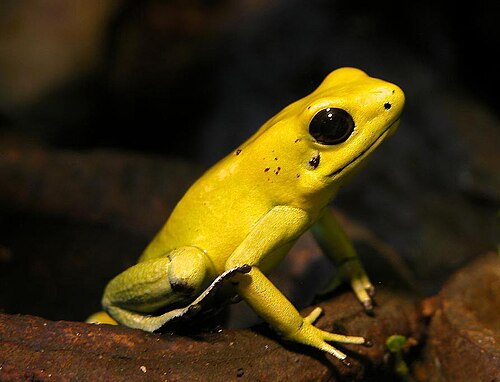
Phyllobates terribilis : Terrible leaf climber
Photo: Wilfried Berns · CC BY-SA 2.0 de · Wikimedia Commons Source
Golden Poison Frog
Phyllobates terribilis (Golden Poison Frog · モウドクフキヤガエル)
💡 Everyday Comparisons for Size, Mass & Speed
- 📏 Length 4.7cm — ~0.5× the width of a credit card (8.56 cm)
- 🧍 Length 4.7cm — ~0.5× the width of a credit card (8.56 cm)
Reference standards: coach bus ~12 m, mid-size car ~4.9 m, compact car ~1 t, basketball hoop 3.05 m, credit card 8.56 cm.
📖 1. Overview
Measuring only 5.5 cm in body length, it is the most toxic vertebrate on Earth, carrying 1 mg of alkaloid neurotoxin (batrachotoxin) in its skin—enough to fatally poison 10–20 adults.
🌐 Wikipedia Summary ExtractThe golden poison frog, also known as the golden dart frog or golden poison arrow frog, is a poison dart frog endemic to the rainforests of Colombia. The golden poison frog has become endangered due to habitat destruction within its naturally limited range. Despite its small size, this frog is considered to be the most poisonous extant animal species on the planet.
🦴 2. Anatomy & Morphology
Its vivid golden coloration serves as warning coloration (aposematism) that signals its lethal toxicity to predators, while a mutation in its own neural sodium channels prevents it from being poisoned by its own toxin.
🔍 3. Ecology & Behavior
Because the toxin is accumulated by eating specific toxic ants and beetles in the wild, individuals raised in laboratories on a diet of ordinary crickets develop no toxin at all.
🇰🇷 4. Connection to Korea
It is a classic example illustrating bioaccumulation of toxins through the food chain and evolutionary warning coloration.
📚 Sources & References
- • Wikipedia “Golden poison frog”
- • Wikidata Q963997
- • IUCN Red List category EN — latest assessment at iucnredlist.org
- • animaldiversity.org — Phyllobates terribilis
- • Silhouette: PhyloPic — Andy Wilson · CC0 1.0
Recorded dimensions are widely cited representative estimates from public literature and may vary by study or specimen.