 🦴 Fossil
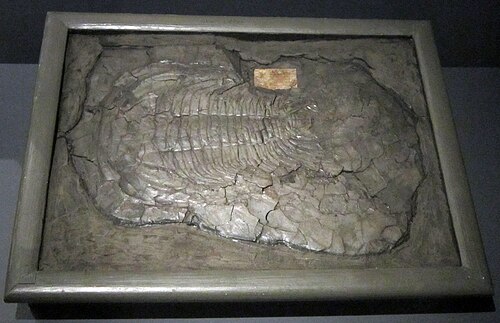
This P. paradoxissimus specimen at the Copenhagen Zoological Museum was described by Carl Linnaeus
Photo: FunkMonk · CC BY-SA 3.0 · Wikimedia Commons Source
Trilobite (Paradoxides)
Paradoxides davidis (Trilobite (Paradoxides) · 三葉虫)
Known only from fossils. The IUCN Red List assesses only species extant since 1500 CE, so fossil taxa are not assigned a category.
💡 Everyday Comparisons for Size, Mass & Speed
- 📏 Length 45cm — ~1.5× the long side of an A4 sheet (29.7 cm)
- 🧍 Length 45cm — ~1.5× the long side of an A4 sheet (29.7 cm)
Reference standards: coach bus ~12 m, mid-size car ~4.9 m, compact car ~1 t, basketball hoop 3.05 m, credit card 8.56 cm.
📖 1. Overview
A representative index fossil that dominated the seas for about 270 million years during the Paleozoic Era.
🌐 Wikipedia Summary ExtractParadoxides is a genus of large to very large trilobite found throughout the world during the Middle Cambrian period. One record-breaking specimen of Paradoxides davidis, described by John William Salter in 1863, is 37 cm (15 in). The cephalon was semicircular with free cheeks ending in long, narrow, recurved spines. Eyes were crescent shaped providing an almost 360° view, but only in the horizontal plane. Its elongate thorax was composed of 19–21 segments and adorned with longish, recurved pleural spines. Its pygidium was comparatively small. Paradoxides is a characteristic Middle-Cambrian trilobite of the 'Atlantic' (Avalonian) fauna. Avalonian rocks were deposited near a small continent called Avalonia in the Paleozoic Iapetus Ocean. Avalonian beds are now in a narrow strip along the East Coast of North America, and in Europe.
🦴 2. Anatomy & Morphology
Trilobites had compound eyes with lenses made of calcite (calcium carbonate) crystals. They are among the oldest eyes preserved as fossils.
🔍 3. Fossil Record & Paleoecology
They vanished completely from Earth during the end-Permian mass extinction.
🇰🇷 4. Connection to Korea
Countless trilobite fossils are excavated from the Paleozoic Joseon Supergroup in Taebaek and Yeongwol, Gangwon-do.
📚 Sources & References
- • Wikipedia “Paradoxides”
- • Wikidata Q7134471
- • Fossil taxon — the IUCN Red List assesses only species living or extinct since 1500
- • Silhouette: PhyloPic — Charles Doolittle Walcott (vectorized by T. Michael Keesey) · Public Domain Mark 1.0 (Related taxon silhouette — Olenellus thompsoni)
Recorded dimensions are widely cited representative estimates from public literature and may vary by study or specimen.