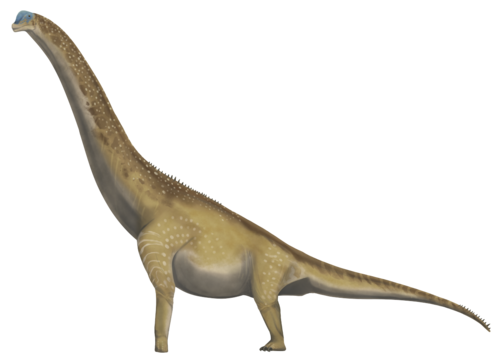
 🎨 Restoration
Life restoration
Restoration: Charles Nye · CC BY-SA 4.0 · Wikimedia Commons Source
Life restorations are artistic reconstructions based on fossil evidence; true coloration and soft-tissue details remain uncertain.
Brachiosaurus
Brachiosaurus altithorax (Brachiosaurus · ブラキオサウルス)
Known only from fossils. The IUCN Red List assesses only species extant since 1500 CE, so fossil taxa are not assigned a category.
💡 Everyday Comparisons for Size, Mass & Speed
- 📏 Length 22m — ~1.8× the length of a 12 m coach bus
- 🏢 Height 13m — ~4.6 building stories tall (~2.8 m per floor)
- ⚖️ Mass 45t — Equivalent to ~45 compact cars (~1 t each)
- ⚡ Speed 18km/h — ~4.5× human walking speed (~4 km/h)
Reference standards: coach bus ~12 m, mid-size car ~4.9 m, compact car ~1 t, basketball hoop 3.05 m, credit card 8.56 cm.
Site-computed relative index from recorded values; not a formal scientific metric.
📖 1. Overview
With forelimbs longer than its hindlimbs and a head height reaching 13 m (4–5 stories of an apartment building), it was a representative giant sauropod of the Jurassic.
🌐 Wikipedia Summary ExtractBrachiosaurus is a genus of sauropod dinosaur that lived in North America during the Late Jurassic, about 155.6 to 145.5 million years ago. It was first described by American paleontologist Elmer S. Riggs in 1903 from fossils found in the Colorado River valley in western Colorado, United States. Riggs named the dinosaur Brachiosaurus altithorax; the generic name is Greek for "arm lizard", in reference to its proportionately long arms, and the specific name means "deep chest". Brachiosaurus is estimated to have been between 18 and 22 meters long; body mass estimates of the subadult holotype specimen range from 28.3 to 46.9 metric tons. It had a disproportionately long neck, small skull, and large overall size, all of which are typical for sauropods. Atypically, Brachiosaurus had longer forelimbs than hindlimbs, which resulted in a steeply inclined trunk and a proportionally shorter tail.
🦴 2. Anatomy & Morphology
Pneumatic cavities connected to air sacs were well developed inside its neck and back vertebrae, reducing bone weight and maximizing respiratory efficiency.
🔍 3. Fossil Record & Paleoecology
It walked across the Jurassic plains consuming hundreds of kilograms of conifer leaves each day.
🇰🇷 4. Connection to Korea
It belongs to the same lineage as the trackmakers of the giant sauropod footprint fossils found in Goseong, Haenam, and Uiseong on the Korean Peninsula.
📚 Sources & References
- • Wikipedia “Brachiosaurus”
- • Wikidata Q22105849
- • Fossil taxon — the IUCN Red List assesses only species living or extinct since 1500
- • nhm.ac.uk — brachiosaurus.html
- • Silhouette: PhyloPic — Michael P. Taylor · CC0 1.0
Recorded dimensions are widely cited representative estimates from public literature and may vary by study or specimen.