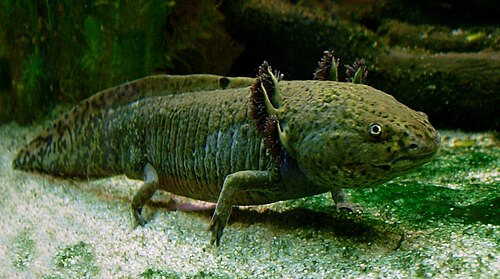
 📸 Photo
Axolotl
Photo: LoKiLeCh · CC BY-SA 3.0 · Wikimedia Commons Source
Axolotl
Ambystoma mexicanum (Axolotl · メキシコサラマンダー (ウーパールーパー))
💡 Everyday Comparisons for Size, Mass & Speed
- 📏 Length 30cm — ~1× the long side of an A4 sheet (29.7 cm)
- ⚖️ Mass 60g — Equivalent to ~1 chicken eggs (~60 g each)
Reference standards: coach bus ~12 m, mid-size car ~4.9 m, compact car ~1 t, basketball hoop 3.05 m, credit card 8.56 cm.
Site-computed relative index from recorded values; not a formal scientific metric.
📖 1. Overview
It is a representative amphibian exhibiting neoteny, breeding underwater while retaining its flower-like larval external gills into adulthood without undergoing metamorphosis.
🌐 Wikipedia Summary ExtractThe axolotl is a species of mole salamander. It is neotenic, reaching sexual maturity without undergoing metamorphosis, and the adults remain fully aquatic with obvious external gills. Axolotls may be difficult to distinguish from the larval stage of other neotenic adult mole salamanders, in particular the tiger salamander, or other species such as mudpuppies.
🦴 2. Anatomy & Morphology
It possesses an astonishing stem-cell regeneration capacity, able to regrow not only limbs and tail but also the spinal cord, parts of the heart, and even damaged brain tissue completely to their original state without scarring.
🔍 3. Ecology & Behavior
With a massive genome of 32 billion base pairs (32 Gb)—10 times the size of the human genome—it serves as a key model organism in modern regenerative medicine and aging research.
🇰🇷 4. Connection to Korea
It is one of the most popular amphibians, widely known in Korea under the name 'Wooper Looper.'
📚 Sources & References
- • Wikipedia “Axolotl”
- • Wikidata Q22718
- • IUCN Red List category CR — latest assessment at iucnredlist.org
- • animaldiversity.org — Ambystoma mexicanum
- • Silhouette: PhyloPic — Jake Warner · CC0 1.0
Recorded dimensions are widely cited representative estimates from public literature and may vary by study or specimen.